Retail Industry
OSHA Compliance · Holiday & Peak Coverage · Slip & Fall Triage · MSK Prevention · Part-Time Benefits · All 50 States
Your Cashier Slipped on Black Friday at 11pm. Your HR Manager's Phone Goes to Voicemail.
Without clinical guidance, there are only two outcomes for a retail injury after closing: push through and risk worsening an injury that later files a claim — or call an ambulance and create an automatic OSHA recordable and a workers’ comp case that follows your store for three years. Your retail operation is open 7 days a week, holidays included. Your occupational health program shouldn’t clock out at 5pm. HealthcareLive gives every store manager on every shift a board-certified physician in under 10 minutes — triaging slip & falls, back injuries, and customer incidents before they become recordables and workers’ comp claims.
Board-certified triage <10 min — any store, any state, any shift
83.6% of injuries resolved without ER or OSHA recordable
Holiday & Black Friday surge coverage — no blackout dates
Benefits for part-time workers — New!
Stretch & Flex — pre-shift back & foot injury prevention
300+ languages — covers diverse retail workforces nationwide

<10 min
83.6%
HCL-managed retail injuries resolved without ER visit or OSHA recordable — first-aid determination by a licensed physician
<$1000
Average HCL-managed injury cost vs. $28,000+ for an unmanaged slip & fall workers’ comp claim
+31%
The Retail Workforce Health Crisis
Your store is open 7 days a week. Your workers get hurt on all of them. Your occupational health program is open Monday through Friday, 9 to 5.
HealthcareLive closes that gap for every retail employer, at every location, on every shift. A board-certified occupational medicine physician is on the line in under 10 minutes. Injuries are triaged by a licensed clinician — not a store manager guessing from the first-aid manual. OSHA work-relatedness is determined at the point of care. Modified duty is assigned before the shift ends. And when the injured worker goes home knowing they were seen and cared for, the retention data shows they come back.
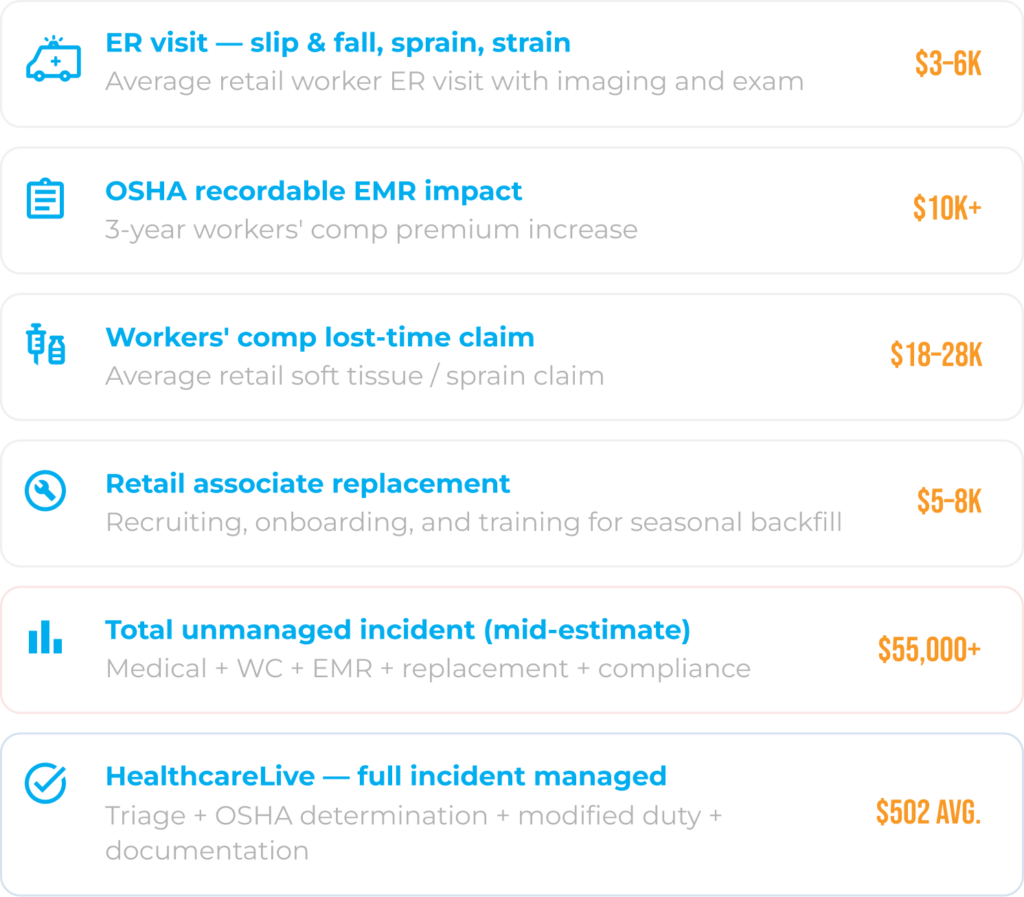
The $55,000 Gap — One Unmanaged Retail Slip & Fall
Average retail injury ER visit with imaging and exam
<$1000
The Four Crises HealthcareLive Solves for Retail
The Holiday Shift With No Nurse
Every injury that happens after 5pm on a Friday goes to the ER — and becomes an automatic OSHA recordable.
Retail’s injury frequency spikes during peak seasons — Black Friday, holiday rush, back-to-school — precisely when stores run maximum staff with minimum management coverage and zero medical resources. A cashier who sprains their ankle at 10pm on Thanksgiving has one option without HealthcareLive: the ER. HealthcareLive gives every store manager on every shift the same clinical resource as a hospital occupational health clinic — in under 10 minutes, 24/7/365, on any device.
Slip & Falls — The #1 Retail OSHA Recordable
Slip and fall incidents are the most common — and most preventable — source of OSHA recordables in retail.
Back Injuries & the Stockroom Gap
Stock associates lift hundreds of pounds per shift. Without pre-shift conditioning and same-day triage, those injuries become multi-week lost-time claims.
60% Annual Turnover & the Benefits Gap
Retail has the highest voluntary turnover rate in the US economy. Workers who feel unsupported when they get hurt don't come back.
The retail industry averages 60%+ annual voluntary turnover — driven by low wages, irregular schedules, and a workforce that largely has no access to healthcare benefits. Part-time workers — who represent a majority of retail employees — are almost universally excluded from employer-sponsored health coverage. HealthcareLive’s benefits bundle extends real health coverage to part-time retail workers for the first time — and the retention data shows that workers who feel cared for stay longer.
OSHA Compliance & Incident Cost
The $55,000 slip and fall. The <$1000 triage. The 10-minute window
that determines which one you get this holiday season.
recordable is on your 300 log for three years. Every point on your EMR raises your
workers’ comp premium — compounding through your next three renewals. Here is
what a managed vs. unmanaged retail incident actually costs your operation.
Cashier slips on wet floor at 10:30pm. Manager has no clinical guidance. Standard protocol: “Let me call an ambulance to be safe.” Worker goes to ER.
ER visit + imaging: $3,000–$6,000
OSHA recordable + EMR impact: $10,000+
WC lost-time claim: $18,000–$28,000
OSHA 300 log recordable. Workers’ comp renewal premium rises. District manager requires incident report for every injury this quarter.
Compliance + admin: $3,000–$5,000
Board-certified occ-med in 10 min. First-aid determination made. No ER. No recordable.
Manager opens HCL portal. Incident documented. Board-certified physician on call in under 10 minutes.
T + <10 min — physician on call
No ER. No OSHA recordable created.
Worker retained — zero productivity gap
No WC claim. 40% faster RTW if needed.
OSHA 301 auto-filed with physician documentation. Record stored in employer dashboard. No 300 log entry. No EMR impact. No premium increase.
Zero recordable. EMR unchanged.
Total: <$1000 average per incident
The recordable that raises your premium for three consecutive renewal cycles
The OSHA first-aid determination is the most consequential clinical decision in retail occupational health — and it must be made by a qualified healthcare professional, not a store manager. An ER visit for a minor ankle sprain creates an automatic OSHA recordable. That recordable enters your Experience Modification Rate calculation and compounds your workers’ comp premium for the next three years. HealthcareLive’s occ-med physicians make the first-aid determination in real time at the point of injury — before the ER decision is made, before the ambulance is called, and before the record is created.
<10 min
+40%
83.6%
HCL retail injuries resolved without any ER visit or OSHA recordable
What a single unmanaged slip & fall or stock injury actually costs your retail operation
Retail Injury Profile — By Type & Cause
Slip & falls. Back strains. Repetitive motion. Workplace violence.
HealthcareLive has a clinical pathway for every retail injury type.
high-frequency incidents that compound into major workers’ comp cost through volume, not severity. The
intervention that changes the cost trajectory is same-shift clinical triage, not post-claim management.
Slip, Trip & Fall — #1 Retail Injury
26%
HCL: Physician triage in <10 min. First-aid determination prevents ER visit and OSHA recordable in 83.6% of cases.
Back & Shoulder — Stocking & Unloading
34%
Back and shoulder strains from stocking, unloading trucks, and overhead shelf work are the leading cause of lost-time claims in retail — and the most preventable through pre-shift conditioning and same-day triage. A back strain caught on the overnight shift and managed with modified duty costs <$1000. The same strain that reaches a workers’ comp attorney the next morning costs $28,000.
HCL: Stretch & Flex pre-shift prevention + same-shift triage. Virtual MSK pathway. Up to 40% faster RTW.
Repetitive Motion & Ergonomic Injury
22%
HCL: Stretch & Flex ergonomic conditioning + virtual MSK care for early-stage repetitive strain. Prevents progression to lost-time claims.
Peak Season Coverage — When Injury Risk Is Highest
Retail injury frequency spikes during Black Friday, the holiday
rush, and back-to-school — exactly when you have the most staff
and the least management coverage.
Holiday Peak
Thanksgiving → New Year's Eve
HCL: No blackout dates. No holiday surcharge. The same physician who covers your store on a Tuesday afternoon is available at 11pm on Thanksgiving. Every seasonal associate is covered from day one of employment.
Inventory & Restocking Season
Overnight Truck Unloads · Floor Resets · Year-Round
HCL: 2am injuries get the same physician response as 9am injuries. Stock crew supervisors initiate from any device. Triage, first-aid determination, modified duty, and OSHA documentation — all completed before the shift ends.
Back-to-School & Spring Surge
July – August · February – March
HCL: Surge capacity is built in. HealthcareLive’s clinical network scales with your seasonal staffing — no advance notice required, no additional setup for new locations or new seasonal hires.
All HealthcareLive Solutions — Retail Employers
Every product in the HealthcareLive platform,
mapped to retail's injury profile, peak-season
coverage gaps, high-turnover workforce, and
part-time benefits challenge.
HealthcareLive is virtual-first — every solution works on any store workstation,
shared tablet, or manager’s mobile device on any shift. On-site specialist
programs deploy to your highest-volume locations. Benefits for part-time and
full-time retail workers.
Core Retail Product · 24/7 Triage · Any Shift · OSHA Recordable Prevention
Remote Injury Care & Virtual Urgent Triage
The foundational retail occupational health solution — board-certified occupational medicine physicians available in under 10 minutes, 24/7/365, on any shift, at any location. This is the product that keeps slip and falls, back strains, and holiday-rush injuries off your OSHA 300 log. Every injury that would have gone to the ER without clinical guidance now gets a physician-level first-aid determination in real time. The most important triage decision in retail occupational health — first aid vs. medical treatment — is made by a licensed clinician, not a store manager with a first-aid manual.

- Slip and fall triage — first-aid vs. ER determination made in real time, preventing the ER visit that creates the OSHA recordable
- Back and shoulder strain assessment — modified duty assigned by the physician at the time of triage, keeping workers on the floor
- Occ-med licensed in all 50 states — retail-specific clinical protocols for slip & falls, lifting injuries, and repetitive strain
- Same-shift triage for overnight stock crews — the shift that generates the most injuries and has the least medical coverage
- Customer incident documentation for loss prevention — clinical record of injury or non-injury documented at the time of the event
Pre-Shift Prevention · Back & Foot · Stockroom & Cashier
Stretch & Flex · Body Mechanics for Retail
Cashier · stock associate · loss prevention routines
7-minute sessions on any break room device or tablet
- Low-back and hip conditioning for cashiers and floor associates — reduces the postural injuries of sustained standing
- Shoulder and wrist conditioning for stock associates — overhead reach, box carry, and scanning injury prevention
- Foot and knee protocols — plantar fasciitis and knee pain prevention for high-step-count retail roles
- OSHA VPP-compatible participation tracking — 300+ languages for multilingual retail workforces
OSHA · Workers' Comp · EMR Protection · Return-to-Duty
Occupational Health & Injury Management
- OSHA 300/300A/301 integration — auto-generated, inspection-ready, multi-location accessible
- EMR protection — physician-documented first-aid determinations that keep incidents off your 300 log
- Workers' comp case management — modified duty documentation reduces lost-time claim frequency
- Pre-employment physicals and drug screens for high-volume seasonal hiring
Virtual MSK · Physical Therapy · Return-to-Full-Duty
Virtual MSK Care & Physical Therapy
- Ankle and knee sprain recovery — designed for the retail worker who needs to be on the floor, not in a clinic twice a week
- Low-back recovery for stocking and lifting injuries — modified duty maintained throughout PT pathway
- Shoulder and wrist rehabilitation for cashier and stock associate repetitive strain injuries
- Virtual PT sessions on any device — no clinic appointment, no shift-time loss, no transportation barrier
Drug Screening · Post-Accident · Pre-Employment · Random
Drug & Alcohol Screening
- Post-accident drug test ordered <2 min from incident record — physician-ordered, OSHA-compliant documentation
- Pre-employment screening integrated with high-volume seasonal hiring workflows
- 11,000+ collection sites — GPS-dispatched to nearest location from any retail address
- Random pool management — single-location or chain-wide consortium programs
Mental Health · EAP · Substance Use · Shift Worker Support
Behavioral Health & Employee Assistance
- Therapist and counselor access in days — not 6-week waitlists through a traditional EAP
- Critical incident response — post-traumatic support after robbery, assault, or violent shoplifting confrontations
- Holiday burnout and stress management — timely support during peak-demand periods when retail stress peaks
- Substance abuse program referral and return-to-duty SAP coordination
- 100% confidential, HIPAA-compliant — protected from employer access
On-Site · High-Volume Plants · Ergonomics · Prevention Coaches
On-Site Health & Ergonomics Programs
- On-site deployment at locations with 200+ workers or during peak seasonal periods
- Ergonomics assessment — production line, assembly, forklift, press environments
- Injury prevention coaching + OSHA VPP program documentation support
- On-site occupational health nurse for plants without clinical staff
Primary Care · Chronic Disease · Retail Workforce Health
Virtual Primary Care & Chronic Disease Management
- Preventive care and wellness visits — on any device, no commute to a clinic
- Hypertension and T2DM management for the high-prevalence conditions in retail workforces
- Foot and ankle care — plantar fasciitis, heel pain, and chronic joint conditions that affect floor workers' productivity and retention
- Sleep and fatigue management — critical for workers on rotating shifts and irregular schedules
Complete Benefits · Full-Time & Part-Time Retail Workforce
Benefits Bundle for Retail Employers ✦
Covers part-time workers — the majority of your retail workforce
+31% voluntary retention increase among benefits-enrolled retail workers
Benefits navigation in 300+ languages — multilingual retail workforces
- Medical, dental, and vision for full-time and part-time hourly workers
- Benefits advocates who help first-time benefits users navigate and actually use their coverage
- Rx cost optimizer — reduces prescription costs that are a top financial stressor for retail workers
- Mental health and EAP integrated — no separate referral or additional enrollment required
- Works for seasonal workers with flexible enrollment windows aligned to retail's hiring cycles

Regulatory & Compliance Context
Every slip and fall sent to the ER becomes an OSHA 300 log entry. Each entry can raise workers’ comp premiums for three years. The 5-minute window at the point of injury changes everything.
OSHA 29 CFR 1904 — Injury & Illness Recordkeeping
The 300 log is your liability record and your workers' comp rate driver — every entry costs you for 3 years
OSHA General Duty Clause — Slip & Fall Hazard Abatement
OSHA expects employers to have a recognized hazard abatement program for slip and fall risks — and to respond to incidents with documented clinical care

Key Regulations — HealthcareLive Coverage for Retail
- OSHA 29 CFR 1904 — Injury & Illness Recordkeeping (300/300A/301
- OSHA General Duty Clause — Slip & Fall Hazard Response Documentation
- OSHA 29 CFR 1904.35 — Post-Accident Drug Testing Anti-Retaliation
- Workers' Comp EMR — Experience Modification Rate Protection
- HIPAA — All clinical records and worker health data protected
- SOC 2 Type II — Data security certified for multi-location retail operations
Post-Accident Drug & Alcohol Testing — OSHA 1904.35
Post-accident testing must be incident-based, clinically justified, and carefully documented to comply with OSHA anti-retaliation provisions
Workers' Compensation — Experience Modification Rate
Your EMR is the cumulative cost of three years of OSHA recordables — and it compounds on every workers' comp renewal
Retail Sub-Sectors
Healthcarelive supports every retail
segment—from single-store boutiques
to 1,000-location national chains—
with occupational health and benefits
built for how each business operates.

Big Box & Mass Retail

Grocery & Supermarket

Department Stores

Convenience & Gas Station Retail
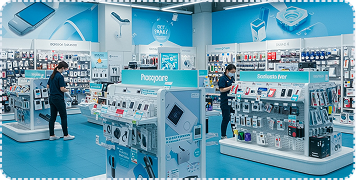
Specialty Retail

E-Commerce Fulfillment & Last Mile
Benefits
Retail Employer Outcomes
Documented results from retail
employers and high-turnover
service-industry organizations
using the HealthcareLive platform
— on OSHA recordables, workers'
comp costs, employee retention,
and medical spend.
–90%
Direct medical spend reduction
<$1000 average per injury vs. $6,000+ industry average ER visit — and a fraction of the $39,000–$57,000+ loaded cost of an unmanaged retail slip and fall with OSHA recordable, workers’ comp claim, and associate replacement.
86.3%
Injuries resolved without ER or recordable
83.6% of HCL-managed retail injuries resolved with first-aid and modified duty — no ER visit, no OSHA recordable, no workers’ comp claim opened. The physician-level triage decision at the point of injury is the single most valuable clinical intervention in retail occupational health.
+31%
Voluntary retention increase
Retail workers with access to same-shift injury care and HealthcareLive benefits show a 31% increase in voluntary retention vs. comparable workers without HCL coverage. In an industry averaging 60%+ annual turnover, that retention lift represents the most measurable ROI of any retail HR investment.
96%
Employee recommendation rate
Regional Grocery Chain — 48 Locations · 3,200 Associates
–47%
-18%
Workers’ comp premium at first renewal post-HCL
+28%
VP Human Resources & Safety
Common Objections — Answered
What Retail HR Directors, District Managers, and CFOs say before they see HealthcareLive in action — and why every concern is already addressed in the platform.
"Our store managers can handle minor injuries without a doctor."
Store managers are skilled at retail operations — not medical triage. The decision that matters most in a retail injury is not whether to apply ice or call an ambulance. It’s the OSHA work-relatedness and first-aid vs. medical treatment determination — which must legally be made by a qualified healthcare professional to protect your 300 log. The store manager who sends an injured cashier to the ER “just to be safe” isn’t being cautious. They’re creating a recordable, a workers’ comp file, and a three-year EMR impact on your next three insurance renewals. HealthcareLive gives that manager a board-certified physician in under 5 minutes to make the determination that actually protects the business — and the worker.
"This is for big box chains. We're a regional operator with 12 stores."
"Our workers' comp insurer manages our claims. We don't need a separate system."
Workers’ comp carriers manage claims after they open. HealthcareLive prevents claims from opening. The average retail workers’ comp lost-time claim costs $18,000–$28,000. HealthcareLive’s $502 triage prevents most claims from ever being filed. For claims that do open, HCL’s clinical documentation — physician-generated, OSHA-compliant, created at the time of injury — accelerates adjuster review and reduces the claim’s total cost. HealthcareLive integrates directly with major workers’ comp carriers — it’s the front-end clinical layer that changes the trajectory of every claim before your carrier’s file is even assigned.
"Our workforce is mostly part-time and seasonal. Benefits don't apply to them."
This is exactly the problem HealthcareLive’s benefits bundle was designed to solve. The majority of retail workers are part-time or seasonal — and they are almost universally excluded from traditional employer-sponsored health coverage. That benefits gap is the primary driver of retail’s 60%+ annual turnover. Workers who have no healthcare, no injury support, and no benefits have no reason to stay when a competitor offers even marginally better scheduling. HealthcareLive extends real health coverage to part-time workers — and the retention data is unambiguous: workers with HCL coverage stay longer.
+31% voluntary retention increase among HCL-covered part-time retail workers. Benefits for seasonal workers with flexible enrollment windows.
"We need something that works during Black Friday and the holiday rush — those are our highest-risk periods."
"Our retail workforce is diverse and many workers have limited English. Will this work for them?"
Platform Integrations
HealthcareLive integrates with the systems
your retail operation already uses — HRIS,
workers' comp, benefits platforms, and retail
loss prevention systems.
HR Information Systems
Workers' Comp & TPA Integration
Retail & POS Systems
Benefits & Pharmacy Platforms

HIPAA Compliant

SOC2 Type II

OSHA 300/300A Ready

All 50 States Licensed

300+ Languages

SAMHSA Certified Labs

No Holiday Blackouts
Get Your Retail Injury Cost Analysis
See exactly what an unmanaged holiday-season injury costs your stores — and what HealthcareLive would cost to prevent it.
Retail Injury Cost Model
OSHA 300 Log Gap Assessment
Part-Time Benefits Retention ROI
We’ll model the turnover cost reduction from extending benefits to your part-time workforce — replacement cost per associate × your current voluntary turnover rate × the 31% retention lift from HCL coverage.