Construction Industry
Stop Construction Injuries from Becoming Recordables. Stop Recordables from Becoming the Mod Rate That Loses You the Bid.
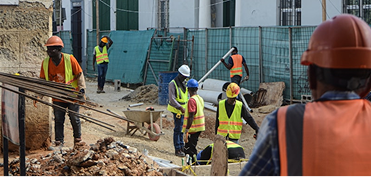
Construction is the third most dangerous industry in the US — and the one where a single recordable injury doesn’t just cost you the claim. It costs you three years of elevated mod rate, higher insurance premiums, and prequalification failures on bids you should win. HealthcareLive puts a board-certified specialist at every job site in under 10 minutes — triaging injuries before supervisors decide to send workers to the ER, documenting every incident completely, and building the prevention program that stops the next one before it happens.
Board-certified triage <10 min — any job site
–90% direct medical spend reduction
83.6% resolved without outside care
3-year mod rate projection included
Post-accident drug screening — chain of custody

#3
3 Years
$104,800
Loaded cost of a single workers’ comp claim without HealthcareLive — surgery + indemnity + productivity loss + replacement labor. With HCL: <$1000 average per injury. 83.6% resolved without outside care
12×























Trusted by leading orthopedic groups across the country
Atlantic Orthopaedic
Campbell Clinic
EmergeOrtho
Proliance Surgeons
Tulsa Bone & Joint
Slocum Orthopedics
OrthoCincy
Rebound Orthopedics
The Construction Healthcare Problem
Every construction employer is managing the same four problems. Most are managing them with solutions built for a different industry.

The ER Default Problem
Foremen send workers to the ER because it's the only option they have

The Dispersed Workforce Problem
12 active job sites — every one is a healthcare access gap
HealthcareLive puts a board-certified specialist at every site simultaneously.
The Subcontractor Problem
Sub injuries show up in your mod rate even when you're not the employer of record
A triage platform can extend to subs at your sites with no additional IT infrastructure.
The Documentation Problem
Incident documentation assembled after the fact is a workers' comp defense liability
HealthcareLive creates the board-certified clinical record at T+5 minutes.
The HealthcareLive Construction Solution
A board-certified specialist at every job site, on every smartphone, in under 10 minutes — with OSHA documentation, mod rate protection, and drug screening.

Triage in <10 minutes at any job site — no clinic required
Any foreman, superintendent, or safety manager can initiate triage on a smartphone. Board-certified specialist on video in under 10 minutes.
83.6% of injuries resolved without outside care — rate protected
Only 10% of HCL-managed injuries require outside care. Every injury that doesn’t reach the ER is a recordable that doesn’t compound your mod rate for three years.
Post-accident drug screening — ordered from the injury record, chain of custody intact
Daily Stretch & Flex before every shift — MSDs before they start
Complete benefits for your full-time workforce
Health, dental, vision, MSK care, and wellness coaching on the same platform managing your job site injury program.
OSHA Fatal Four + Mod Rate Protection
The four injury types that kill construction
workers — and how the ones that aren't fatal
still destroy your mod rate.
OSHA 300 log — back strains, shoulder injuries, knee conditions, lacerations — are the ones that
don’t make headlines. They make mod rate entries. And every one that reaches the ER without a
clinical triage alternative compounds your experience modification rate for three years.
Fatal Four #1

Falls
HCL triage: immediate clinical assessment, fracture vs. sprain determination, ER routing only when clinically indicated — not as default. Stretch & Flex: balance and stability work for fall risk reduction.
Fatal Four #2
Struck-By
HCL triage: immediate severity assessment after any struck-by event — distinguishing minor bruising from internal injury, head trauma screening, and post-accident drug screen ordered from same record.
Fatal Four #3
Electrocution
HCL triage: immediate post-electrical event assessment, documentation for OSHA Severe Injury Reporting (SIR) requirements, and coordination with emergency services when clinically indicated.
Fatal Four #4
Caught-In/Between
Caught-in/between events — equipment, cave-ins, rotating machinery — produce some of the highest-severity non-fatal injuries in construction and require immediate clinical assessment
HCL triage: immediate severity triage for any entrapment or crush event, emergency services coordination, OSHA 300 documentation from T+5 minutes.
The Mod Rate Compounding Problem
A recordable in Year 1 doesn't just cost you the claim. It costs you three years of elevated insurance premiums and bid prequalification penalties.
Year 1
0.88
Year 2
1.14
Year 3
1.31
The 3-year window means it takes three years of improved performance to fully repair a bad claims year. Every recordable prevented this year is compounding in your favor for the next three. HealthcareLive clients see an average mod rate reduction of 0.15–0.20 points in the first full program year.
A back strain on a job site doesn’t have to cost $104,800. HealthcareLive closes the default ER path at the point of triage.
Without HCL
Foreman sends to ER — no clinical resource available
ER visit: $1,389
3-week specialist wait. Off work during wait.
Indemnity: $3,600
Mod impact: $60,000+
With HealthcareLive
T+0 minutes
No recordable created
No lost time
No indemnity. No replace.
<$1000 avg.
The Mod Rate Compounding Problem
Every product in the HealthcareLive platform,
mapped to construction's specific injury,
compliance, and workforce challenges.
HealthcareLive is a virtual-first platform — every solution works from any smartphone, tablet, or computer at any
job site. On-site specialist programs are available at your highest-volume sites or permanent facilities and benefits
available for your full-time workforce.
Core Construction Product · Virtual-First
Remote Injury Care · Board-Certified Triage <10 Min at Any Site
Job site deployment: any smartphone, any site, any trade. Works on cellular — no job site WiFi required. Superintendent or safety manager initiates in under 60 seconds.
- Board-certified specialist <10 min — any site, any time zone
- 83.6% of injuries resolved without outside care — no ER, no recordable
- OSHA 300 documentation created at T+5 min — board-certified, timestamped
- Post-accident drug screen ordered from injury record — chain of custody intact
- 40% faster return to full duty vs. standard care
Daily Prevention · Pre-Shift
Stretch & Flex · Pre-Shift MSD Prevention
Job site deployment: foreman leads digital session on job site tablet or screen. Role-specific routines for every construction trade. Participation tracked per site, per shift.
- –28% MSD frequency reduction — construction trades specifically
- 300+ routines: back, shoulder, knee, wrist — top construction injury zones
- Early symptom detection → automatic triage routing before recordables
- Fleet dashboard: participation rate per site, per shift, per trade
High-Volume Sites · On-Site Deployment
On-Site Programs · Specialist at Your Largest Sites
Construction deployment: on-site at 200+ worker job sites or permanent facilities (shop, yard, office). Virtual-first everywhere else.
- Daily group prevention sessions before every shift — all trades
- Immediate on-site triage — specialist physically present at the incident
- Ergonomic risk assessment for high-risk trades and task types
- Return-to-work coordination with project supervisors and HR
MSK · Recovery · Return-to-Work
Virtual MSK & Muscle-Joint Care
Construction workers with musculoskeletal injuries — back strain, shoulder injury, knee or wrist conditions — enter a fully virtual orthopedic care pathway managed by board-certified specialists. Workers stay on modified duty while recovering.
Job site deployment: mymobility digital recovery app — worker follows care pathway on their phone between shifts. No clinic visits required for most MSK injuries.
- 100 digital care pathways — every construction MSD type covered
- 40% faster return to full duty — worker back on site faster
- Modified duty coordination with superintendent and HR
- Avoids 3-week specialist wait that drives lost time claims
24/7 · Non-Injury Medical
Virtual Urgent Care · 24/7
Job site deployment: any smartphone, any time. Crew member uses HCL app for non-injury medical needs — not just injury triage. Reduces absenteeism from untreated illness.
- Provider in under 20 minutes — prescription and ca
- 96% of urgent care visits resolved without requiri
- Reduces absenteeism from untreated illness and delays
- Fleet dashboard: participation rate per site, per shift, per trade
Post-Accident · DOT · SAMHSA
Drug Screening & Compliance
Construction-specific: DOT drug testing for CDL operators on site. Post-accident chain of custody starts at the HCL injury report — no handoff gap between injury documentation and screen order.
- Post-accident screen ordered from injury record in <2 min — no gap
- DOT 49 CFR Part 40 compliant for CDL-operating site equipment operators
- SAMHSA-certified labs + licensed MRO review on every screen
- 20,000+ collection sites — workers can collect near any job site
Complete Benefits · Full-Time Field & Office Workforce
HealthcareLive Benefits Bundle — Health, Dental, Vision & More for Your Full-Time Construction Workforce
Construction application: full-time field workers, project managers, estimators, and office staff — the workforce you're competing to retain in a tight labor market.
- Health, dental, and vision for full-time field and office workforce
- MSK care included — the injury type that drives most construction claims
- Wellness coaching for the mental health and physical demands of field work
- Virtual Urgent Care 24/7 — crew uses it for injury and illness from same app
- Single enrollment, single renewal — HR manages one platform for all programs
The Mod Rate Compounding Problem
What managing healthcare across 12 active job sites actually looks like — when it works.
The defining operational challenge for mid-size and large construction companies is that your healthcare problem is distributed across every job site you’re running simultaneously. The injury at the bridge project 40 miles from your office, the one at the downtown high-rise where your super is up on the 18th floor — all need a clinical triage resource in under 10 minutes. HealthcareLive is one platform deployed across all of them from the moment your workers arrive on site.
Live scenario — Ironworker shoulder injury, Highway 45 Bridge, 9:12 AM
9.12
Ironworker reports shoulder pain after overhead lift — Pier 6 work platform
Superintendent opens HealthcareLive on phone. Incident documented in 45 seconds: mechanism, body zone, initial pain level. Timestamp locked.
9.16
Board-certified specialist connected — clinical assessment begins
9.24
Clinical determination: Grade II AC strain — conservative care, modified duty
9.26
Post-accident drug screen ordered — from the injury record, 2 clicks
9.28
Complete record in employer dashboard — safety director notified
<$1000 avg. cost · No ER · No recordable · Drug screen ordered · Complete documentation — all from a smartphone at Pier 6
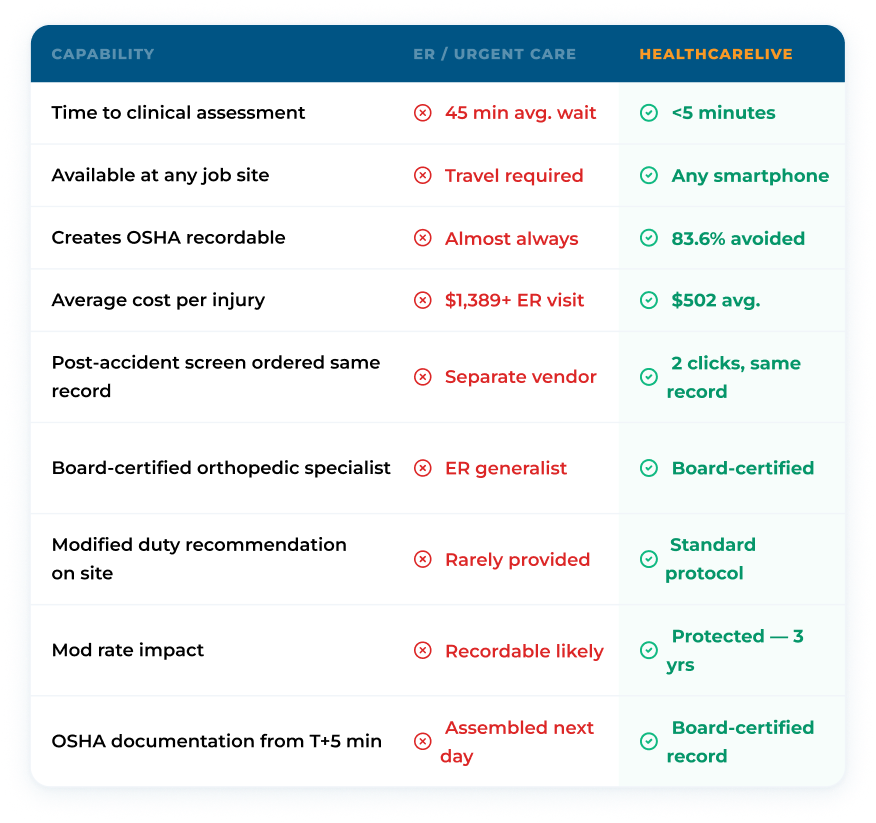
HCL vs. ER Default — 9 Differences
Why routing injured workers to the ER instead of HCL triage costs you 200× more and creates recordables that compound for 3 years.

Construction Sub-Sectors
HealthcareLive serves every segment of the
construction industry — from general
contracting to specialty trades to heavy
civil and residential.
regulatory context. HealthcareLive’s platform adapts to all of them — virtual-first
for every job site, on-site at your highest-volume facilities.
General Contracting
High Volume · Multi-Site · Subcontractor Complexity
Remote Injury Care
On-Site (HQ/Yard)
Stretch & Flex
Benefits
Drug Screening

Specialty Trades
High MSD + Electrical Exposure
Remote Injury Care
On-Site (HQ/Yard)
Stretch & Flex
Benefits
Drug Screening
Heavy Civil & Infrastructure
Highest Severity · Remote Locations
Remote Injury Care
On-Site (HQ/Yard)
Stretch & Flex
Benefits
Drug Screening

Residential & Multifamily
High Volume · High Turnover
Remote Injury Care
On-Site (HQ/Yard)
Stretch & Flex
Benefits
Drug Screening

Industrial & EPC Construction
Large Crews · Prequalification Pressure
Remote Injury Care
On-Site (HQ/Yard)
Stretch & Flex
Benefits
Drug Screening
Demolition & Renovation
Highest Hazard Exposure
Remote Injury Care
On-Site (HQ/Yard)
Stretch & Flex
Benefits
Drug Screening
OSHA Compliance
The OSHA reporting standards, recordkeeping requirements, and drug testing obligations construction employers need — built into the platform.
OSHA 300 Log — Work-Related Injury Recordkeeping
Board-certified recordability assessment at T+5 min
300A Summary — Annual Posting & Electronic Submission
Complete recordable data in employer dashboard
Severe Injury Reporting — 24-Hour Notification
Clinical record supports SIR submission
29 CFR 1926 — OSHA Construction Safety Standards
Construction-specific triage standards

Post-Accident Drug Testing — The Construction Compliance Gap
Every construction injury that could be drug-related needs a post-accident screen ordered immediately — from the same record as the injury report.
Post-Accident
Pre-Employment
Random Pool
DOT (CDL Operators)
Return-to-Duty
Reasonable Suspicion
Construction Outcomes
Documented results from construction
and high-physical-demand employers using
HealthcareLive — on OSHA recordables,
workers' comp costs, and mod rate.
HealthcareLive is a virtual-first platform — every solution works from any smartphone, tablet, or computer at any
job site. On-site specialist programs are available at your highest-volume sites or permanent facilities and benefits
are available for your full-time workforce.
–90%
Direct medical spend reduction
<$1000 avg. per injury vs. $6,000+ industry average — and significantly less than the $104,800 loaded cost of a claim that reaches surgery, indemnity, and productivity loss
83.6%
Injuries resolved without outside care
Every injury resolved without ER or specialist referral is a potential OSHA recordable that doesn’t compound your mod rate. HCL clients report avg. –40% OSHA recordable rate in first full program year
40%
Faster return to full duty
Workers managed through HCL’s virtual MSK care pathway return to full duty 40% faster than the standard specialist referral pathway — reducing lost time, replacement labor cost, and project schedule impact
12×
ROI on workers' comp spend
HCL + workers’ comp program ROI — including medical spend reduction, indemnity savings, productivity recovery, and 3-year mod rate improvement value compounding across the project portfolio
Berkshire Hathaway — Industrial Operations
–40%
12×
<$1000
Avg. cost per injury — HCL managed
Safety & Risk Management Leadership

Robert Kamara
Robert Kamara
Robert Kamara
Construction-Specific Questions, Answered
The objections Safety Directors, VPs of Safety, Risk Managers, and CFOs raise — addressed fully.
"Our foremen and supers won't adopt a new technology on the job site."
"We have a clinic relationship / workers' comp carrier panel. Won't this conflict with our existing program?"
HealthcareLive is a triage and care pathway platform — not a replacement for your carrier relationship or your panel clinic. The HealthcareLive triage session is the first clinical contact that determines whether the injury requires referral to your panel clinic, a specialist, or can be managed conservatively. When HL triage determines that outside care is needed, the specialist coordinates the referral to your panel provider. When HCL triage determines the injury can be managed conservatively — which happens 83.6% of the time — the panel clinic visit never occurs, and your relationship with your carrier is unchanged.
"We have seasonal and project-based workers. Enrollment is too complicated."
"Our job sites don't have reliable cellular or WiFi coverage."
"What about workers who don't speak English? Our crews are multilingual."
"How quickly can we get this deployed across all our active sites?"
A HealthcareLive construction deployment can be active across all job sites within 10 business days of contract execution. The platform requires no on-site hardware, no IT integration with existing systems, and no clinic infrastructure — it deploys as an app on existing smartphones that your supervisors already carry. The deployment process: (1) Employer dashboard configured — typically 2–3 days. (2) Supervisor orientation — 30-minute virtual session. (3) Drug screening program configured — collection site network mapped. (4) First triage capability available — day one. A Benefits enrollment launch requires 60 days of onboarding lead time.
One Platform. All Solutions.
Every HealthcareLive product available to
construction employers — on one platform,
one dashboard, managed by one safety or
HR team member.
and a post-accident drug screen share one timestamp. A worker in virtual MSK recovery has
the same record as the original triage. Prevention participation data and injury frequency data
are in one dashboard.
Any site · Any phone · <10 min
Remote Injury Care
Stretch & Flex
On-Site Programs
Virtual MSK Care
Virtual Urgent Care
Post-accident · DOT · SAMHSA
Drug Screening
Full-time workforce
HealthcareLive Benefits
Health, dental, vision, MSK care, and wellness coaching for your full-time field and office workforce — on the same platform managing job site injury care.
Employer Dashboard & Mod Rate Tracking

SOC2 Type II

HIPAA Compliant

OSHA 300 / 300A

SAMHSA-Certified Labs

300+ Languages

86.6 NPS Score
Virtual-First · Any Shift
Talk to a Construction Specialist
Get your 3-year mod rate projection, OSHA recordable cost model, and job site deployment plan — before your first conversation with our construction team.
3-year mod rate projection — with and without HCL
Based on your current claim history and workforce size, we’ll project the mod rate trajectory with HCL in place — and quantify the bid competitiveness improvement in year 1, 2, and 3 of the program.
OSHA recordable cost model — your numbers
Job site deployment plan — all active projects
2026 construction employer injury cost benchmark report
Talk to a Construction Specialist
Every recordable injury you prevent today protects your mod rate — and your bids — for three years.
Put a Board-Certified Specialist at Every Job Site Before the Next Injury Becomes a Recordable That Costs You a Bid.
No spam. HIPAA & SOC2 compliant. We’ll build your 3-year mod rate projection, recordable cost model, and site deployment plan before the call — so the first conversation is immediately productive.