Food Production
An injury on your production line costs the claim, the shift, and your mod rate. Fix all three in under 10 minutes.
Food production injuries don’t just create workers’ comp claims, they disrupt operations. HealthcareLive connects any shift, in any language, to a board-certified specialist in under 10 minutes to triage injuries, keep workers on modified duty when appropriate, and help prevent the next one.
Triage <10 min — any shift, any facility
300+ languages — every crew covered
83.6% injuries resolved without outside care
E-COMMERCE FULFILLMENT COMPANY: $6,000 → <$1000/injury, 96% recommend
24/7 three-shift coverage
#1
$25K/hr
<10 Min
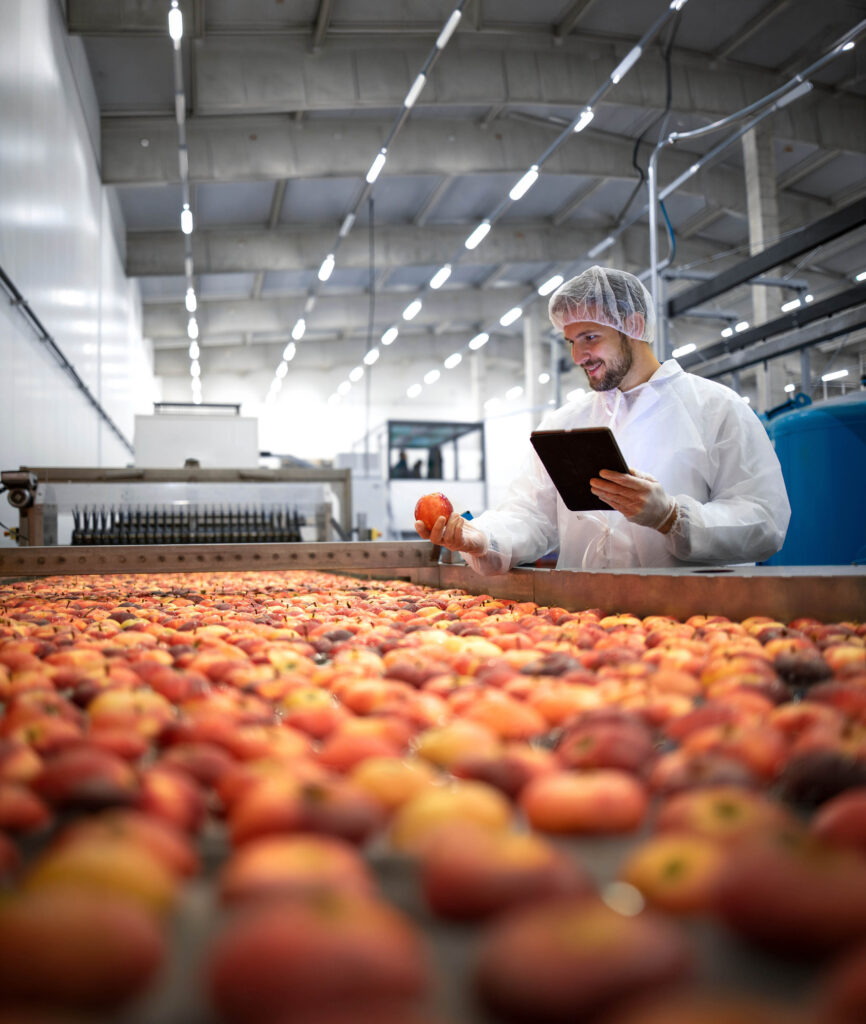
HealthcareLive board-certified triage response — any shift, any language, any facility. The worker is assessed at the line in under 10 minutes, a modified duty assignment is made clinically, and the worker returns to the production floor the same shift in 83.6% of managed injury cases.
300+
The Food Production Healthcare Problem
Food production has a unique injury problem: the same motion that runs your line wears down the worker doing it.
Repetitive cuts, lifts, reaches, and wrist rotations—combined with cold, wet, high-speed environments—drive some of the highest cumulative trauma rates in manufacturing. And because every worker impacts throughput, injury costs go beyond the claim to immediate production loss. The triage decision made in the first 10 minutes can determine whether the line pauses briefly—or loses hours.

Repetitive Motion Epidemic
The same motion that runs your line 8 hours a day is destroying your workers' wrists, shoulders, and backs

24/7 Operations Problem
Injuries happen on third shift at 3am — when HR is home and the nearest urgent care is closed
Extreme Environment Hazards
Extreme Environment Hazards
Multilingual Workforce Care Gap
A crew that speaks 12 languages has 12 different healthcare access barriers
The HealthcareLive Food Production Solution
Virtual-first care on every shift, in every language — with the prevention program that stops repetitive motion MSDs before they stop your line.

Board-certified triage <10 min — 24/7, every shift
Day, swing, third shift — supervisor initiates triage on a facility tablet or phone. Specialist on video in under 10 min. Modified duty assigned. Line continues
300+ languages — every worker in their first language
Daily pre-shift Stretch & Flex — stops MSDs before they start
83.6% of injuries resolved without outside care
83.6% of HCL-managed injuries resolved with modified duty on the line — no ER, no recordable, no 3-week specialist wait. Line impact minimized in the large majority of managed injury events.
Post-accident drug screening — from injury record, chain of custody intact
Screen ordered from the same HCL platform in under 2 minutes. Critical for night shift: supervisor orders at 3am, chain-of-custody starts immediately — no waiting for morning HR.
The Real Cost of a Food Production Injury
What actually happens when a worker is hurt
on the line — and why the <$1000 vs. $104,800
outcome is decided in the first 10 minutes.
The food production injury cost calculation has two components that don’t appear in other
industries at this scale: the workers’ comp claim cost and the production throughput loss.
HealthcareLive addresses both — by resolving the triage decision at the facility in under 10
minutes instead of at the ER 4 hours later.
T+0 — throughput loss begins
Supervisor drives worker to ER 20 min away. Line runs short-staffed or halts for 4+ hours.
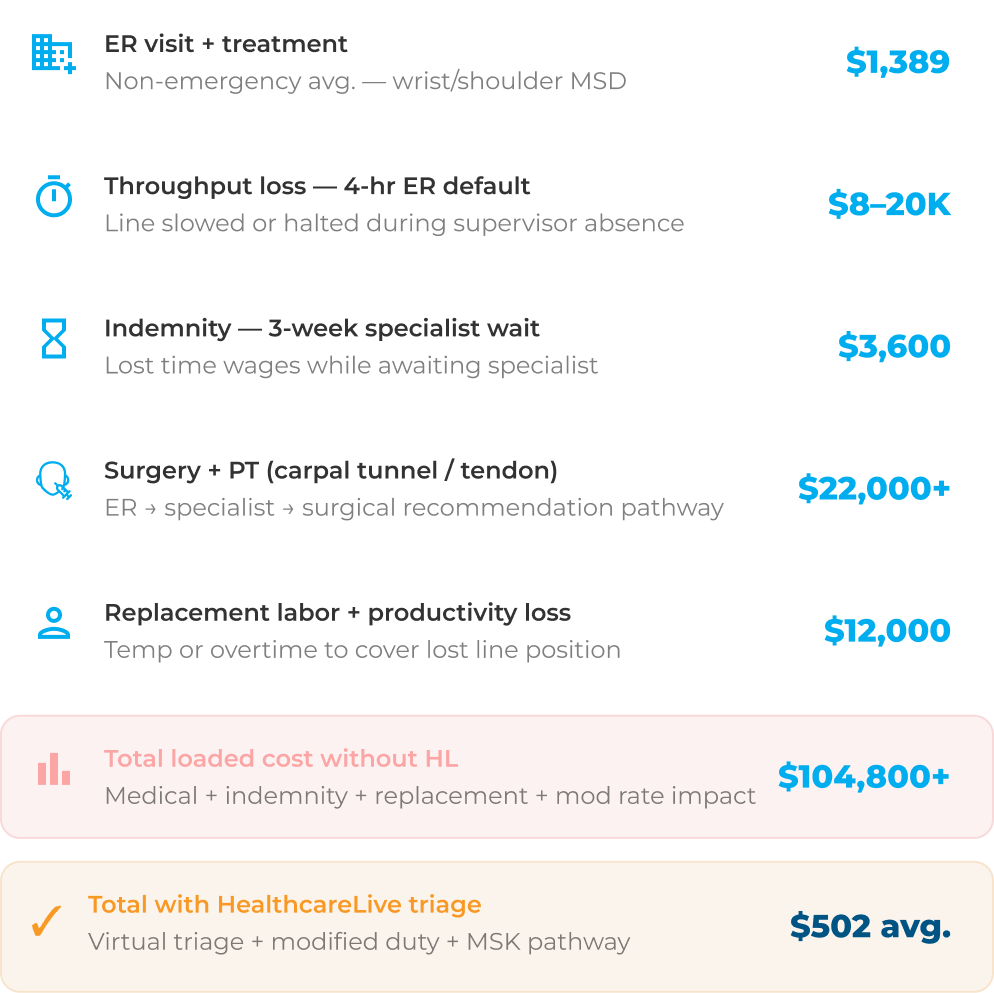
Throughput loss (4 hrs): $8,000–$20,000
ER visit — 4.5-hour avg. wait. OSHA recordable created. Workers’ comp claim opened.
ER visit: $1,389 + claim
Indemnity (3 weeks): $3,600
Surgery + recovery: $22,000+
Mod rate impact: $60,000+ over 3 yrs
T+0 — documentation starts
T+3 min — no line stop
Specialist determines: Grade I wrist flexor strain. Modified station assigned. Worker returns to production.
No ER. No recordable. Line runs.
No lost time. No replacement.
No indemnity. No surgery.
Mod rate protected — 3 years
Total: <$1000 avg. per incident
Most employers calculate the workers' comp cost of an injury. Almost none calculate the throughput cost. In food production, throughput is often larger.
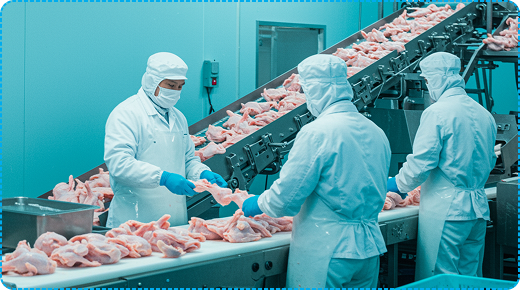
A high-speed poultry deboning line running at capacity processes 80–140 birds per minute. A line-critical deboner removed and sent to the ER creates a cascade: the line slows or stops, the supervisor is off the floor for 3–4 hours, overtime may be required on the next shift, and yield quality suffers when a trained deboner is replaced by a floater. The HealthcareLive value proposition in food production is not just workers’ comp cost reduction — it’s the production stability value of resolving the triage decision at the facility, in under 10 minutes, on every shift. The worker gets assessed. The modified duty assignment is made by a clinician. The line continues.

Full Injury Cost — Single Wrist Strain, Without HCL
Every line item that turns a manageable injury into a six-figure claim.
24/7 Operations — The 3-Shift Healthcare Gap
Every shift has an injury risk. Only one shift
has an HR manager in the building.
shift — and the night shift injury that goes to the ER at 3am is the one that most reliably
becomes a recordable, because there’s no clinical alternative available.
HCL: Specialist connected before the supervisor finishes the incident form. Modified duty assigned before HR is even notified.
HCL: Clinical triage available on any facility device. Specialist decision takes the “should I send them?” judgment call out of a non-clinical supervisor’s hands.
HCL: 24/7 coverage means the 3am injury gets the same clinical response as the 9am injury. Specialist on, modified duty assigned, drug screen ordered, documentation complete — before morning HR arrives.
Repetitive Motion MSDs — Food Production's #1 Injury Type
The four body zones food production destroys — and the prevention program that stops the damage before it becomes a claim.
HCL: 64 wrist/hand routines — cold-environment specific. Early symptom flag → triage before Grade III escalation.
HCL: 72 shoulder routines — overhead and lateral reach specific. Rotator cuff injury prevention.
HCL: 58 low back routines — prolonged standing and seated posture specific. Lumbar mobility and core stability.
HCL: 48 lower extremity routines — wet-floor standing specific. Ankle stability and knee mobility.


Cold exposure reduces manual dexterity and nerve conduction velocity. Workers performing high-repetition motions with significantly reduced neuromuscular protection are at peak cumulative trauma risk. The pre-shift warm-up in a cold facility isn’t optional — it’s clinical injury prevention, not corporate wellness.
Wet environments — meat, poultry, and produce processing — create persistent slip-and-fall risk. Workers in rubber boots have reduced proprioceptive feedback, increasing ankle and knee injury risk. HCL’s lower extremity routines specifically address the stability demands of wet-surface work environments.
Workers in baking, cooking, and beverage production face sustained heat exposure accelerating fatigue and creating heat illness risk. HCL Virtual Urgent Care provides immediate physician access for heat-related symptoms on any shift — preventing heat exhaustion escalations that become OSHA Severe Injury Reports.
All HealthcareLive Solutions — Food Production
Every product in the HealthcareLive platform, mapped
to food production's specific injury, throughput,
compliance, and workforce challenges.
HealthcareLive is a virtual-first platform — every solution works on any facility device
on any shift. On-site specialist programs are deployed at your highest-volume production
facilities. Benefits are available for your full-time workforce.
Core Food Production Product · Daily Prevention
Stretch & Flex · Pre-Shift MSD Prevention
Supervisor leads digital session on the production floor before line start. Role-specific routines for each station type. Cold-environment specific wrist and hand routines. Early symptom detection flags workers for triage before Grade III escalation.
- 300+ routines — wrist, shoulder, back, knee for all food production roles
- –28% MSD frequency reduction — documented across HCL employer clients
- Cold-environment specific — no outdoor or heated space required
- Participation tracked per shift, per line, per facility — employer dashboard
Learn more
24/7 · Any Shift · Any Device
Remote Injury Care · Board-Certified Triage <5 Min
The triage platform that closes the ER default at the facility. A supervisor initiates on any facility tablet or smartphone, a board-certified specialist is on video in under 5 minutes, a modified duty assignment is made clinically — and the line keeps running. Every shift, every language, every facility.
Works on facility WiFi. Triage in the worker's language. Modified duty assigned by the specialist — not a non-clinical supervisor. Line impact minimized in 83.6% of managed cases.
- Board-certified specialist <10 min — 24/7, day/swing/night shift
- 83.6% resolved without outside care — line continues
- 300+ languages — every food production crew nationality covered
- OSHA 300 documentation at T+5 min, board-certified, timestamped
Learn more
300+ Worker Facilities · On-Site Deployment
On-Site Programs · Specialist at Your Largest Facilities
Deployed at 300+ worker production facilities. Virtual-first everywhere else — smaller facilities and satellite operations covered by Remote Injury Care. One platform across both layers.
- Daily group S&F on the production floor before every shift
- Individual ergonomic assessment for high-risk positions (deboning, packaging)
- Immediate in-person triage — specialist at the incident within minutes
- Workstation redesign recommendations for cumulative trauma prevention
MSK · Recovery · Modified Duty RTW
Virtual MSK & Muscle-Joint Care
Worker follows digital recovery pathway on personal phone outside shift hours. Modified duty coordination is clinically defined — what tasks the worker can and cannot do at each recovery stage is specified by the specialist, not guessed by the line supervisor.
- 100 digital pathways — all food production MSD types (wrist, shoulder, back, knee)
- 40% faster return to full duty — worker back on full line faster
- Clinically-defined restrictions per recovery stage → supervisor clarity
24/7 · Non-Injury Medical · Any Language
Virtual Urgent Care · 24/7
Food production workers access a board-certified provider in under 20 minutes for non-injury medical needs — illness, infection, respiratory conditions, heat illness symptoms — from any shift, in their language. Eliminates missed shifts and ER visits for conditions that a phone call could resolve.
Critical for night shift workers with no other medical resource at 3am. Primary access for heat illness assessment in bakery and cooking line environments — preventing heat exhaustion escalations before they become OSHA Severe Injury Reports.
- Provider in under 20 minutes — prescription issued remotely
- 96% of visits resolved without in-person care — no missed shift
- Heat illness assessment — critical for bakery and cooking line workers
Learn more
Post-Accident · Pre-Employment · SAMHSA
Drug Screening & Compliance
Night shift capability is the key differentiator in food production — the shift supervisor can initiate a compliant post-accident screen from the HCL app at any hour. No HR required. Chain-of-custody clock starts at incident documentation.
- Post-accident screen ordered from injury record in <2 min — any shift
- SAMHSA-certified labs + licensed MRO review on every screen
- DOT testing for CDL-operating forklift and delivery drivers
Complete Benefits · Full-Time Production & Administrative Workforce
HealthcareLive Benefits Bundle — Health, Dental, Vision & MSK Care for Your Full-Time Food Production Workforce
Food production employers face intense competition for full-time, experienced production workers — and the workforce you can retain with competitive benefits is safer, more productive, and less likely to leave mid-production ramp. HealthcareLive Benefits delivers health, dental, vision, MSK care, and wellness coaching for your full-time production and administrative workforce on the same platform managing facility injury care. One enrollment, one renewal, one platform.
Experienced deboners, packagers, and production leads have specialized skills you can't replace quickly — retaining them with competitive benefits is worth the program cost. The same platform they use for injury triage now manages their full healthcare benefits.
- Health, dental, and vision for full-time production and administrative staff
- MSK care included — the injury type driving most of your production claims
- Wellness coaching — mental health and physical recovery support for production workers
- 300+ languages — benefits enrollment and management in workers' language
300+ Languages
Food production facilities employ some of the
most linguistically diverse workforces in US
manufacturing. HealthcareLive covers every
language — so every worker is assessed in the language
they think and feel pain in.
speaks English. Language-inaccessible triage creates clinical errors, delayed care decisions, and consent documentation
failures that become OSHA and workers’ comp complications. HealthcareLive covers every language your facility employs.

Spanish

Somali

Burmese

Karen

Haitian Creole

Vietnamese

Nepali

Hindi

Mandarin

Khmer

Mam / K'iche'

Amharic

Arabic

Portuguese

Romanian

Polish
Plus 284+ more languages — every triage call, urgent care visit, care plan, Stretch & Flex session, and benefits enrollment interaction available in the
worker’s first language. Spanish has dedicated Spanish-speaking specialists on every shift as standard routing.

Food Production Sub-Sectors
HealthcareLive serves every segment of
the food production industry — from
high-speed protein processing to
beverage, bakery, produce, dairy, and seafood.
— virtual-first on every shift, on-site at your highest-volume operations.
Highest MSD + Laceration Rate
The highest-injury-frequency food production segment. High-speed deboning and cutting at 40–80 reps/minute in cold environments creates peak wrist, shoulder, and hand injury density. HCL Stretch & Flex deployed before every shift; on-site specialists at 300+ worker facilities.
Stretch & Flex
On-Site (300+)
Drug Screening
Remote Triage
Virtual MSK
Heat Exposure + Overhead Reach
Stretch & Flex
Remote Triage
Benefits
Virtual Urgent Care
Virtual MSK
Beverage Production
Wet Floors + High-Speed Lines
On-Site Programs
Remote Triage
Benefits
Stretch & Flex
Drug Screening
Produce & Fresh Processing
Seasonal Workforce + Cold/Wet
Remote Triage
Pre-Employment Screens
Stretch & Flex
300+ Languages
Dairy & Cold Chain
Cold Environment + Heavy Equipment
Stretch & Flex
Remote Triage
Benefits
Virtual MSK
Seafood Processing
Coldest Environment + Highest Repetition
Virtual MSK
Remote Triage
Stretch & Flex
On-Site (300+)
Food Production Outcomes
Documented results from food
production and high-physical-demand
employers using HealthcareLive — on
MSDs, medical spend, throughput, and
employee experience.
HealthcareLive is a virtual-first platform — every solution works from any smartphone, tablet, or computer at any
job site. On-site specialist programs are available at your highest-volume sites or permanent facilities. Benefits
available for your full-time workforce.
–90%
Direct medical spend reduction
<$1000 avg. per injury vs. $6,000+ industry average. E-Commerce Fulfillment Company: $6,000 → <$1000/injury (95% reduction). Plus line throughput protection value not captured in medical spend metrics.
83.6%
Injuries resolved without outside care
83.6% of HCL-managed food production injuries resolved with modified duty on the line — no ER, no recordable, no 3-week specialist wait. Line throughput protected in the large majority of managed cases.
-29%
MSD frequency reduction
Documented MSD frequency reduction with HCL Stretch & Flex prevention programs in food production — stopping repetitive motion injuries at the pre-shift stage before they generate OSHA 300 entries and claims.
96%
Employee recommendation rate
Based on aggregate outcomes across HealthcareLive employer clients in food production and adjacent high-physical-demand manufacturing industries, 2022–2025. E-Commerce Fulfillment Company data reflects employer-specific results. MSD reduction reflects clients with active Stretch & Flex programs ≥6 months. Sources: HealthcareLive internal data; BLS; OSHA; National Safety Council.
E-Commerce Fulfillment Company
“We went from $6,000 per injury to <$1000 per injury — a 95% reduction — and 96% of our employees say they would recommend HealthcareLive to a coworker. But the number that changed everything for our operations team wasn’t the medical spend. It was how many workers stayed on the floor instead of going to the ER.”
<$1000
–38%
96%
Safety & Workforce Health Leadership
High-volume fulfillment operations

Thomas Okonkwo
Linda Farouk
Marcus Chen
Food Production Questions, Answered
The objections Plant Safety Managers, VP Operations, Plant HR Directors, and food production CFOs raise before deploying HealthcareLive — addressed directly.
"We already have a nurse line. How is this different?"
Nurse lines triage symptoms and give general guidance — they cannot assess an injury visually, cannot assign a clinical care pathway, cannot produce a return-to-work protocol, and cannot initiate specialist follow-up. HealthcareLive connects injured employees to a board-certified specialist via video in under 10 minutes — the specialist sees the injury, conducts a structured assessment, assigns a validated care pathway, and issues first report of injury documentation. A nurse line is a phone tree. HealthcareLive is clinical care at point of injury.
"Can a virtual visit really assess a physical injury accurately?"
"Our employees won't use an app when they're injured on the floor."
"What about OSHA documentation and workers' comp reporting requirements?"
"We have employees across 20 locations in 8 states. Can HealthcareLive cover all of them?"
"How do I build the ROI case for my CFO or PE board?"
Food Production Questions, Answered
The objections Plant Safety Managers, VP
Operations, Plant HR Directors, and food
production CFOs raise before deploying
HealthcareLive — addressed directly.
Objection 01
"Our line supervisors won't adopt a new app or technology on the production floor."
This is the most common concern before deployment and the first thing employers say has not been an issue after. HealthcareLive is a phone call with a doctor, initiated in under 60 seconds on a device the supervisor already has. The adoption driver isn’t training — it’s the first time a supervisor doesn’t have to drive an injured worker to urgent care for 4 hours and miss the rest of their shift. HCL clients report 80%+ voluntary supervisor adoption within 30 days, without any mandated usage requirement. The onboarding is a 30-minute virtual orientation — no IT setup, no hardware, no integration required.
Objection 02
"Our workers are too diverse — we can't standardize a healthcare program across languages and cultures."
This objection is the reason HealthcareLive was built with 300+ language support as a core capability, not an add-on. Standardizing triage documentation, clinical records, and OSHA reporting across a linguistically diverse workforce is actually easier with HCL than without it — because every clinical interaction creates the same structured record regardless of the language it was conducted in. Spanish-speaking specialists are available as standard routing on every shift. For Somali, Burmese, Karen, Haitian Creole, and other food production workforce languages, real-time translation is provided. The care plan, consent documentation, and follow-up instructions are in the worker’s language.
Objection 03
"We already have a workers' comp carrier and a panel of occupational health clinics."
HealthcareLive is the first-contact triage layer — not a replacement for your carrier relationship or panel clinic. The HCL triage session determines whether the injury requires referral to your panel clinic or can be managed conservatively without outside care. When HCL triage determines outside care is needed (16.4% of managed cases), the specialist coordinates the referral to your panel provider. When conservative management is appropriate (83.6% of cases), the panel clinic visit never occurs, the recordable is often prevented, and your carrier relationship is unchanged. HCL works within your existing workers’ comp structure, not around it.
Objection 04
"Our workers on third shift don't have smartphones or personal devices."
Objection 05
"We're a food production facility — HACCP and food safety audits limit what can happen on the production floor."
Objection 06
"We have seasonal workforce peaks — enrollment is too complicated for variable headcount."
HealthcareLive supports variable-enrollment food production operations with flexible enrollment structures that activate and deactivate workers as seasonal demand changes. For pre-employment drug screening, the screen can be completed before the worker’s first shift — no waiting for HR to coordinate. For seasonal triage and prevention access, enrollment can be tied to facility headcount and adjusted monthly without a contract renegotiation. Benefits enrollment is structured for full-time permanent employees specifically — seasonal and temporary workers access triage and drug screening as separate modules without requiring full benefits enrollment.
One Platform. All Solutions.
Every HealthcareLive product for food
production employers — one platform, one
dashboard, managed by one safety or HR team
member.
The value of the platform is that every solution shares the same record. A triage event
and post-accident drug screen share one timestamp. A worker in virtual MSK
recovery has the same record as the original triage.
Prevention data and injury frequency data are in one dashboard.
Stretch & Flex
24/7 · Any shift · <10 min · 300+ languages
Remote Injury Care
On-Site Programs
Virtual MSK Care
100 digital pathways for food production MSDs — workers stay on modified duty during recovery. 40% faster return to full duty, clinically-defined restrictions for supervisor clarity.
Virtual Urgent Care
Drug Screening
Full-time workforce
Benefits Bundle
Health, dental, vision, MSK care, and wellness coaching for your full-time production and administrative workforce — on the same platform managing facility injury care.
Employer Dashboard
Talk to a Food Production Specialist
Get your line throughput cost analysis, MSD prevention plan, and multilingual deployment roadmap — before your first call with our food production team.
Line throughput cost model — your numbers
Multilingual deployment plan — your workforce languages
Which languages your crew speaks, which shifts have the highest language diversity, and how HCL’s language routing will be configured for your specific workforce composition.
MSD prevention plan — by line and role
2026 Food Production Employer Injury Benchmark Report
Talk to a Food Production Specialist
Put a Board-Certified Specialist on Every Shift, in Every Language, Before the Next Wrist Strain Stops Your Line for Four Hours.
HealthcareLive gives every line supervisor on every shift at every facility a board-certified specialist in under 10 minutes — in the worker’s language, with a modified duty assignment that keeps the worker in production. The throughput cost of today’s unmanaged injury is larger than the annual cost of HCL for your entire facility. The food production specialist call is 30 minutes. Your line throughput analysis is ready before you walk in.