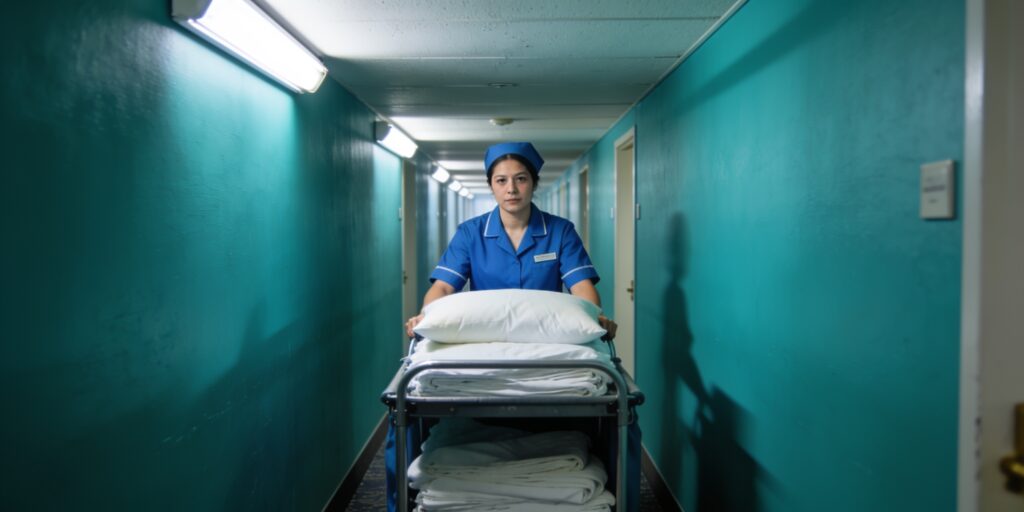
Your Room Attendant Just Hurt Her Back Making Her 14th Bed of the Day. It's 6 am Saturday. Your HR office opens at 9.
Hotel room attendants sustain injuries at rates far above the national average. Housekeeping is one of the most physically demanding occupations in the American economy and most properties have no occupational health coverage during the early morning turn, the late shift, or any hour on weekends. HealthcareLive gives every housekeeper, every kitchen worker, and every maintenance tech the same-shift care they deserve. At every property, every shift, around the clock.
300+
15–20
24/7
Hotel operations. Most properties have occ health for one shift
#1

Hotel room attendants sustain musculoskeletal injuries at rates significantly above the national average, making housekeeping one of the most injury-dense occupations in the American service economy. Most properties have no occupational health coverage during the early morning turn, the evening shift, or weekends, exactly when housekeeping injuries are most common. HealthcareLive covers every shift.







The Problem Hospitality Employers Face
Your Hotel Never Closes. Your Occupational Health Does: Every Night at 5pm, Every Weekend, Every Holiday.
A 400-room hotel runs three distinct operational periods every day. The morning turn runs from 6am and is your highest-intensity housekeeping period: checkout rooms stacked back-to-back, 120 room attendants moving through the property, and the peak ergonomic stress of the entire day happening before most HR managers arrive at the office. The evening shift runs front desk, food and beverage, and maintenance operations through midnight. The overnight runs security, emergency maintenance, and early kitchen prep.
In all three of these operational periods, when a housekeeper strains her back, when a prep cook burns himself on the salamander, when a maintenance tech falls off a ladder changing a bulb in a corridor, there is almost never an occupational health resource available to manage that injury at the time it occurs. The worker either goes to urgent care in the morning, goes to the ER and generates an expensive claim, or pushes through and doesn’t report it at all until the injury becomes a chronic WC case weeks later.
For hotel management companies operating 10, 20, or 50 properties, the problem multiplies. The corporate safety director has the right program on paper. At the property level, the tool to execute it, a physician available at 6am Saturday when the first injury call comes in, simply doesn’t exist. Until HealthcareLive.
The Core Gap“Housekeeping injuries happen at 6am, 7am, and 8am on Saturday and Sunday mornings, when 80% of your room attendants are working the checkout turn and your HR office is closed. That’s not a coverage program. That’s a gap that generates a workers’ comp claim every time.”

#1
Housekeeping back injury, leading WC cost in hospitality

48%
Peak hotel occupancy, and therefore peak housekeeping workload, falls on weekends and holidays, exactly when HR and occ health coverage is lowest. The Saturday morning checkout turn is the highest-injury, lowest-coverage operational period in the hotel industry.

$22K
A housekeeping back strain managed at the time of injury with same-shift physician evaluation and modified duty documentation is typically resolved in 3-5 days. The same injury managed by default (ER visit, no modified duty, no follow-up) becomes a 3-4 week lost-time claim averaging $22,000.

3.2
OSHA recordable rate per 100 workers in the hospitality industry

70%
Most hotels operate under a brand flag (Marriott, Hilton, Hyatt) but are owned and staffed by independent management companies. These franchisees are the employer of record and carry the WC liability, but often have far less occupational health infrastructure than the brand suggests. HealthcareLive gives every franchised property enterprise-grade occ health coverage.
The Housekeeping Injury CrisisYour Room Attendant Makes 14 Beds Every Day. That's 4,200 Ergonomic Stress Movements Before Lunch.
The math of housekeeping work is brutal. A room attendant assigned 15 rooms per shift performs an average of 300 bends, reaches, pulls, and lifts per room: changing sheets, tucking in mattresses, reaching into bathtubs, scrubbing tile, restocking supplies, and pushing a linen cart that can weigh 300 lbs fully loaded. That’s 4,500 high-stress ergonomic movements per shift, compressing lumbar discs and stressing rotator cuffs at a rate that most workers can sustain for a few years before the cumulative damage becomes an acute injury.
15–20
300+

4,500+

300 lbs

250 days
HealthcareLive Housekeeping Protocol
Orthopedic physician <10 min → Back strain severity assessment → First aid vs. medical treatment → Modified duty plan issued → Virtual PT if indicated → OSHA 301 complete → RTW tracking in dashboard
Six Injury Categories Across Hotel & Hospitality Operations
From the Housekeeping Floor to the Kitchen Line. Every Risk Your Hospitality Workforce Faces.
Housekeeping & Room Attendant Injuries
Back strains, shoulder tears, wrist injuries, and knee disorders from the sustained ergonomic demands of room cleaning are the defining occupational injury of the hotel industry. A room attendant making 15 beds in a shift performs over 4,500 high-stress ergonomic movements: bending to tuck sheets, reaching across king-size beds, lifting mattresses to re-fit fitted sheets, scrubbing tile in kneeling postures, and pushing 300-lb linen carts through miles of corridor per shift. HealthcareLive’s orthopedic physicians evaluate every housekeeping injury at the time of the event, issue modified duty plans before the attendant leaves the property, and prevent the weekend back strain from becoming the three-week WC claim.
HealthcareLive Response
Orthopedic physician <10 min → Injury assessment → First aid vs. medical treatment → Modified duty plan issued same shift → Virtual PT coordination → OSHA 301 → RTW tracking

Kitchen & Food & Beverage Injuries
Commercial kitchen environments combine high heat, sharp tools, slippery floors, and extreme time pressure into one of the most injury-dense workplaces in the service economy. Burns from hot surfaces, hot liquids, and steam; knife lacerations from prep work; and ergonomic strains from carrying heavy pots and trays are the dominant injury types in hotel food and beverage operations. Kitchen injuries happen during service peaks (breakfast rush, dinner service, banquet events), when every supervisor is focused on the plates going out, not the line cook who just burned his forearm on the salamander.
HealthcareLive Response

Slips, Trips & Falls
Wet tile in bathrooms and pool decks, freshly mopped lobby floors, kitchen grease accumulation, condensation on laundry room floors, and room service trays on corridor floors create slip and fall hazards distributed across every area of a hotel property. Slip and fall injuries are the most widely distributed injury type in hospitality. They happen in housekeeping, in food and beverage, on the pool deck, in the parking garage, and in the maintenance shop. Many produce head injuries, wrist fractures from protective falls, and ankle injuries that require immediate evaluation to determine whether imaging and ER transport are needed.
HealthcareLive Response

Maintenance & Engineering Injuries
Hotel engineers and maintenance technicians work around the clock. Emergency repairs don’t respect business hours, and many routine maintenance tasks (HVAC filter changes, lighting replacement in public areas, plumbing repairs) happen overnight to avoid guest disruption. Falls from ladders and elevated work platforms, electrical exposure, chemical exposures from HVAC refrigerants and cleaning chemicals, and heavy lifting during equipment replacement are the primary injury types for hotel maintenance teams. Overnight maintenance injuries have the least clinical coverage and the longest gap before any occ health resource is available.
HealthcareLive Response

Workplace Violence & Security Incidents
HealthcareLive Response
Heat Illness & Extreme Environment Exposure
Hotel laundry operations run at temperatures above 100°F from industrial washers and dryers operating continuously. Commercial kitchen environments regularly exceed 90°F at grill and saute stations. Pool attendants, valet staff, and outdoor event workers at resort properties in warm climates face seasonal heat illness risk during peak summer operations. Heat exhaustion and heat stroke in hotel laundry and kitchen environments are significantly underreported because supervisors misidentify the symptoms and workers don’t want to stop their production pace. HealthcareLive’s physicians can assess heat illness severity, guide cooling protocols, and determine when transport is required, before the heat exhaustion event becomes a heat stroke fatality.
HealthcareLive Response
How HealthcareLive Covers Your Property Portfolio
One Platform. Every Property in Your Portfolio. Every Shift, Including the Saturday Morning Turn.
The conventional approach to hotel occupational health is a workers’ comp insurer’s phone number posted in the break room and an urgent care address printed on a card at the front desk. That approach reaches zero employees at 6am on Saturday morning when the checkout turn starts and the first housekeeper goes down. HealthcareLive is one phone number that reaches a board-certified physician in under ten minutes: at 6am Saturday, at 11pm Tuesday, and at 3am when the overnight maintenance tech slips on a wet kitchen floor.
Injury at Any Property, Any Shift
Housekeeper, cook, maintenance tech, or security officer is injured. Supervisor or worker calls HealthcareLive from any device. One number. Every property. 6am Saturday or 3am Tuesday, it doesn’t matter.
→ Available 24/7 at every property simultaneously
Board-Certified Physician on the Line
Occupational medicine physician joins the call. They understand the housekeeping injury profile, kitchen burn management, and the specific ergonomic demands of hotel work. Not a general triage line, but a physician who can evaluate and document the injury in real time.
→ Under 10 minutes from first call
Modified Duty Plan Before the Supervisor Radios Out
First aid vs. medical treatment determination. Modified duty plan appropriate for the worker’s specific hotel role. OSHA work-relatedness determination. The executive housekeeper doesn’t need to make a clinical decision, the physician makes it, documents it, and the supervisor executes the plan.
→ Same-shift clinical management
OSHA Documentation Before Checkout
→ Same-incident documentation, every property
 Real Scenarios at Real PropertiesRoom Attendant · Back Strain
→ HCL physician: lumbar strain confirmed, no red flags. Modified light duty to linen restocking. Shift completed. OSHA 301 done before morning briefing.
Line Cook · Steam Burn→ HCL physician: second-degree partial thickness burn. Wound care instructions. Finish service if pain allows. ER referral for dressing if blistering progresses. OSHA done.
Maintenance Tech · Ladder Fall→ HCL physician: wrist fracture suspected. ER transport recommended. Spinal precaution guidance for ladder fall. OSHA 301 and transport documentation complete.
Security Officer · Assault Incident→ HCL physician: injury assessed. Medical documentation for incident report generated. Orbital fracture evaluation guidance. Behavioral health referral offered.
HealthcareLive for Oil & Gas
Every Product Your Hotel Workforce Needs. Every Property. Every Shift.
Most Critical for Hospitality
24/7 Injury Triage at Every Property
Board-certified occupational medicine coverage for housekeeping back injuries, kitchen burns, maintenance falls, and security incidents on every shift, at every property in your portfolio. Physician on the line in under 10 minutes. Modified duty plan before the room attendant leaves the floor. OSHA documentation before the morning briefing.

Fastest Recovery Path
Virtual Physical Therapy
Video-based PT sessions and individualized home exercise programs for housekeeping back injuries, shoulder strains, and wrist disorders without requiring workers to miss additional shifts for clinic visits. Integrated with HealthcareLive’s orthopedic physician managing the case from day one. The typical housekeeper back strain resolves in 3-5 days with immediate PT guidance vs. 3-4 weeks without.
Prevention
Stretch & Flex for Hotel Crews
Portfolio Intelligence
Multi-Property Analytics
Real-time OSHA 300/301 documentation, injury frequency trend reports by property, by department, by shift, and by injury type, automatically generated from physician-completed triage records. Gives hotel management company safety directors the data to identify which properties, which departments, and which operational periods are driving WC costs before they become regulatory findings.

Behavioral Health
Employee Assistance & Mental Health

Workforce Retention
Employee Benefits for Hospitality Workforces
Comprehensive benefits built for hourly hospitality workforces including telehealth primary care, specialty access, and wellness programs that reach workers regardless of their shift or their proximity to a clinic. In an industry with high turnover, accessible benefits are a meaningful retention differentiator. HealthcareLive benefits reach hotel workers through the same platform they use for injury reporting.
Case Study
How a Hotel Management Company Cut Housekeeping WC Costs by 51% Across 22 Properties by Closing the Weekend Morning Coverage Gap
A regional hotel management company operating 22 branded properties across 8 states had a housekeeping workers’ comp problem concentrated almost entirely in a single operational window: Saturday and Sunday mornings between 6am and noon. That four-hour window generated 61% of their annual housekeeping WC costs, every week, every property, because it was when occupancy peaked, checkout turns were stacked, and no occupational health coverage existed at any of their 22 properties.
−51%
12 days
−73%
−8 days
I knew where our WC costs were coming from before we deployed HealthcareLive. It was always Saturday morning. A housekeeper goes down during the checkout turn, the executive housekeeper does her best, the worker goes to urgent care when it opens at 8am or waits until Monday, and I’m getting a claim notice four days later with a $900 ER bill and no documentation from the time of the injury. HealthcareLive changed that completely. Now the executive housekeeper calls it first. The physician manages it. The modified duty plan is issued. I have a complete OSHA 301 in my email before I’ve had my first cup of coffee. And the worker is still on property finishing her shift on light duty instead of sitting in an ER waiting room.
Every Type of Hospitality Operation
From Budget Hotels to Casino Resorts. One Platform for Every Hospitality Workforce.
Full-Service Hotels & Resorts
Full-service properties with extensive housekeeping, food and beverage, spa, fitness, and conference operations. The most complex injury profile in hospitality: multiple departments, multiple shifts, and the highest employee counts. HealthcareLive deploys across the entire property workforce, providing the same coverage to the overnight maintenance tech that the day-shift manager has at the corporate occ health program.

Casino Resorts
Casino resort operations combine hotel housekeeping and F&B injury profiles with the specific occupational health needs of casino floor workers: dealers, cage workers, and slot attendants who perform sustained repetitive motions for 8-hour shifts, and security staff who face the highest workplace violence rates in hospitality. HealthcareLive covers the full casino resort workforce across all operational areas and all 24 hours of casino operations.

Select-Service & Extended Stay
Limited-service and extended-stay properties operate with smaller teams and less internal HR infrastructure than full-service hotels, but the same injury risks in housekeeping, maintenance, and guest services. Franchise management companies operating these properties rarely have any occupational health infrastructure beyond what the brand mandates. HealthcareLive gives select-service properties the same occ health capability as their full-service counterparts.

Conference Centers & Convention Hotels
Large conference and convention hotel properties run banquet and event operations at extremely high volumes creating peaks of F&B injury risk during major events where kitchens run at maximum capacity, banquet servers carry heavy trays for 10-hour event shifts, and setup crews perform manual handling of tables, chairs, and A/V equipment. Peak event periods generate the highest injury frequency of any operational period at conference properties.

Theme Parks & Attractions

Standalone F&B & Restaurant Groups
Restaurant groups, catering companies, and standalone food service operations share the kitchen injury profile of hotel F&B departments without the hotel’s broader HR infrastructure. Burns, lacerations, and ergonomic injuries from kitchen work are the dominant injury types. The dinner service rush, 6pm to 10pm on Friday and Saturday nights, is when kitchen injuries peak and when no occupational health resource is available.
Talk to Our Hospitality Team
Your Hotel Never Closes. It's Time Your Occupational Health Program Reflected That.
HealthcareLive’s hospitality team works specifically with hotel management companies, casino resorts, and food service operators to build occupational health coverage programs that actually function during the Saturday morning checkout turn, the Friday night dinner service rush, and the 3am maintenance call, at every property in your portfolio.
- Weekend coverage gap analysis across your property portfolio
- Housekeeping injury cost model for your room attendant count
- Multi-property analytics dashboard demonstration
- Kitchen injury and modified duty protocol walkthrough
- Full portfolio deployment in <14 days from contract signature
Get a Hospitality Demo
Your Guests Experience Your Hotel Around the Clock. Your Room Attendants Work Around the Clock. Their Occupational Health Coverage Should Too.
HealthcareLive gives every room attendant, every line cook, and every maintenance tech the same immediate occupational health access at the Saturday 6am checkout turn that your corporate occ health program provides during business hours. 24/7, board-certified, in under 10 minutes. Because the back strain that happens during the busiest checkout of the week deserves a physician, not a voicemail.