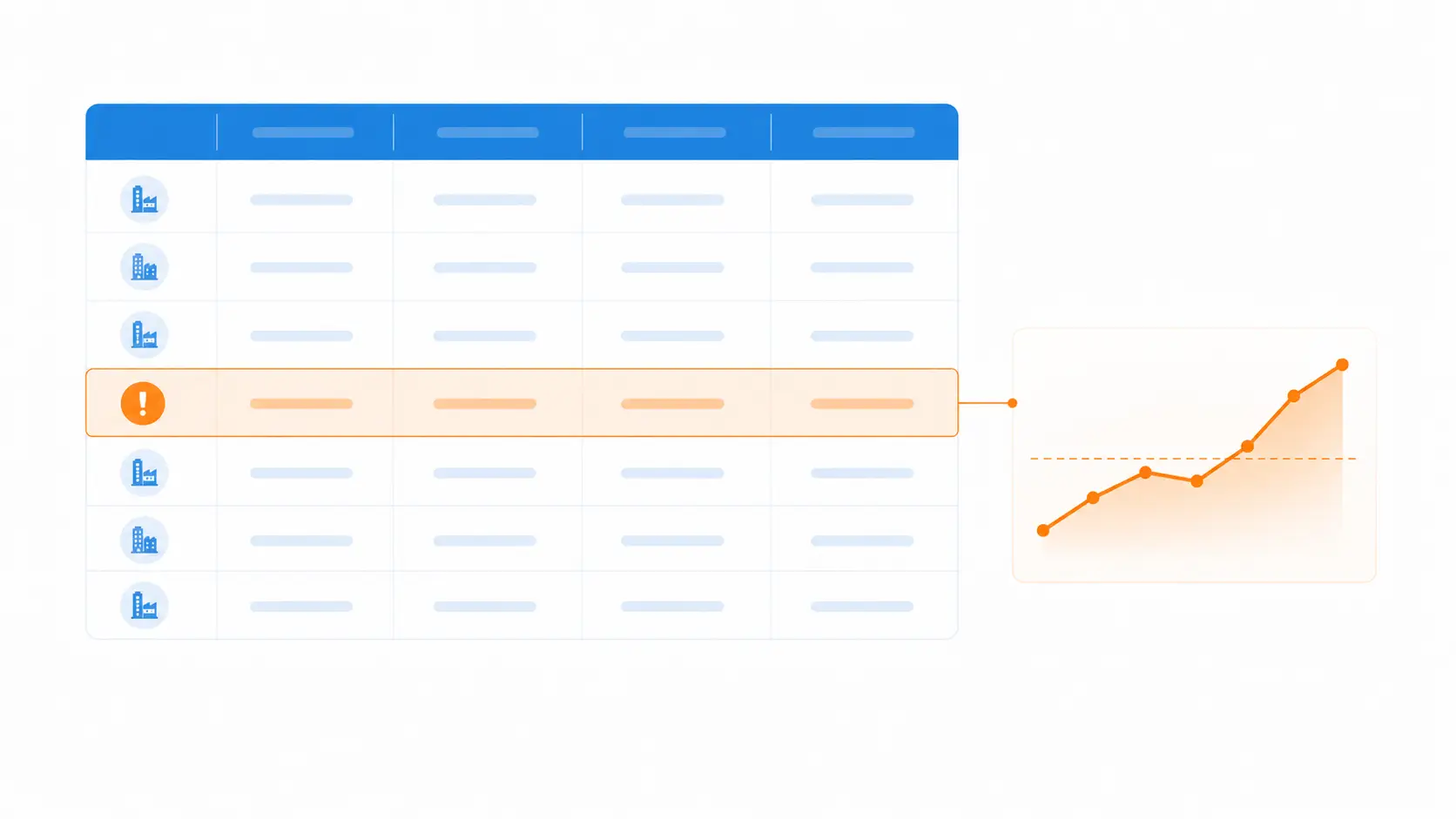
OSHA’s enforcement targeting uses injury data from your 300A submissions. Here is exactly how inspections are triggered, and what a high recordable rate does to your risk profile.
Most employers picture an OSHA inspection as bad luck: an inspector shows up unannounced, and you happened to draw the short straw. For event-driven inspections, that is roughly true. But for the largest category of planned inspections at general industry worksites, there is nothing random about it. OSHA decides which sites to visit using a list, and that list is built from data you provide to the agency yourself every March.
That is the part most safety leaders underestimate. The injury and illness numbers you submit through OSHA’s Injury Tracking Application are not just a compliance chore. They are the selection criteria for the agency’s primary programmed inspection program. A high rate does not just look bad. It mechanically moves your establishment up the target list. Here is exactly how that works in 2026, and what you can do about it.
The five reasons OSHA shows up
OSHA prioritizes its limited resources in a fairly strict order. Understanding the order tells you which triggers you can influence and which you cannot.
- Imminent danger. Any situation that could reasonably cause death or serious physical harm gets top priority and an immediate response.
- Fatalities and severe injuries. Employers must report a work-related fatality within 8 hours, and any inpatient hospitalization, amputation, or loss of an eye within 24 hours. These reports frequently trigger an inspection or a rapid response investigation.
- Complaints and referrals. A worker complaint, a referral from another agency, or a compliance officer can prompt an inspection.
- Programmed inspections. These are the planned, data-driven inspections OSHA schedules on purpose: the Site-Specific Targeting program, National Emphasis Programs on hazards such as heat and on industries such as warehousing and distribution, and regional Local Emphasis Programs.
- Follow-up inspections. Visits to verify that previously cited hazards were actually corrected.
The first three are reactive. You cannot schedule when a worker files a complaint or when a serious injury occurs. But the fourth category, programmed inspections, is different. OSHA chooses those sites in advance, from data, and the single biggest driver of that choice for non-construction employers is your own injury rate.
How Site-Specific Targeting actually works
The Site-Specific Targeting program, or SST, is OSHA’s main planned inspection program for non-construction establishments with 20 or more employees. It exists for one purpose: to point the agency’s inspectors to the worksites whose own data indicate the greatest risk. Only establishments required to submit Form 300A electronically fall within its scope; the smallest employers are generally out of scope, but everyone above that threshold is in the pool.
Here is the mechanism. OSHA takes the 300A data you submit, calculates a DART rate for your establishment, and sorts establishments into selection buckets. DART stands for Days Away, Restricted, or Transferred, and the rate is calculated by taking your count of those cases, multiplying by 200,000, and dividing by the total hours all your employees worked. It is, in effect, a severity-weighted measure of how often your injuries are serious enough to cost time, restrict duty, or force a transfer.
The current SST directive sorts establishments into four groups:
- High-rate establishments. Sites with elevated DART rates based on recent 300A data. Because injury rates differ by sector, OSHA sets one threshold for manufacturing and a separate one for non-manufacturing, and the inspection list typically runs about a 50/50 split between the two. If your DART rate is high for your sector, this is the bucket that catches you.
- Upward-trending establishments. Sites whose rates across the most recent three years are climbing, specifically those at or above twice the private sector national average. You do not have to have the highest rate in your industry to get flagged. A rapidly rising rate is its own trigger.
- Low-rate establishments. A sample of sites with notably low rates was pulled specifically so OSHA can verify that the low numbers are real and not the product of under-recording. Reporting suspiciously clean data does not make you invisible. It can invite a data-quality check.
- Non-responders. A random sample of establishments that failed to submit their required 300A at all. Skipping the submission is itself a way onto the list.
It is worth knowing that this program works, by OSHA’s own measure. Between April 2023 and December 2024, SST produced hundreds of inspections with a higher rate of violations found per inspection than other non-construction programmed inspections. These are comprehensive inspections, not quick looks. And participants in recognition programs like VPP and SHARP are deferred or removed from the list, which is part of why those programs are valuable.
The takeaway is blunt: your DART rate is not a report card OSHA files away. It is the selection criterion.
The submission rules that feed the list in 2026
Because the data drives everything, the recordkeeping and submission rules are worth getting exactly right. As of the 2026 reporting cycle, covering calendar year 2025 data, the electronic submission requirements break down like this:
- You must submit your Form 300A electronically if your establishment had 250 or more employees and is not in an exempt industry, or had 20 to 249 employees and is in one of the high-hazard industries OSHA designates.
- On top of that, establishments with 100 or more employees in the specific high-hazard industries listed in Appendix B must also submit the case-by-case details from their Form 300 logs and Form 301 incident reports, not just the 300A summary. This expanded rule took effect on January 1, 2024, and while OSHA estimates it affects fewer than 1 percent of establishments, those establishments account for nearly 30 percent of all reportable injuries.
- The deadline is March 2 each year. The Injury Tracking Application opens January 2, and missed submissions still have to be filed, but lateness invites exactly the kind of scrutiny you are trying to avoid. Separately, the 300A summary must be posted at the worksite from February 1 through April 30.
One detail people miss: much of this data becomes public. OSHA makes establishment-specific injury data publicly available, so customers, prospective employees, insurers, and competitors can look up your numbers. A high recordable rate is no longer just an internal metric. It is a visible part of your reputation.
What a high recordable rate actually costs you
Put the pieces together and a high or rising DART rate does several things to your risk profile at once.
It raises your odds of a programmed inspection because it is the literal input to the SST list. It makes any resulting inspection comprehensive in scope rather than narrow. And if that inspection finds violations, the financial exposure is significant: effective January 15, 2026, OSHA’s maximum penalty for a serious or other-than-serious violation rose to $16,550 per violation, and willful or repeat violations carry roughly 10 times that amount, exceeding $165,000 per violation. Penalties stack per violation, so a single inspection can produce a six- or seven-figure total.
Beyond OSHA itself, the same injury data influences your experience modification rate and your workers’ comp premiums, shapes how insurers price your risk, and, because it is public, affects how customers and recruits perceive your safety culture. The recordable rate is one number with a very long shadow.
The lever you actually control
Here is the encouraging part. If your DART rate is the thing that puts you on the list, then lowering your DART rate is how you lower your targeting risk, and DART is more controllable than most employers assume, because it is driven by two things working together: preventing injuries, and managing the ones that happen so they do not become days-away, restricted, or transferred cases.
This is where an occupational health program directly and measurably works on your risk profile. Structured injury prevention reduces the recordables that feed your rate in the first place; HealthcareLive’s Stretch & Flex program, built from a site’s own OSHA 300 log, has been associated with a 38% reduction in musculoskeletal recordable injuries in the first year. Immediate clinical care keeps a large share of injuries as medical-only, which keeps them out of the DART count entirely; HealthcareLive’s Remote Injury Care connects an injured worker to an occupational medicine clinician in under 10 minutes, and On-Site Programs place a clinician in the building. Faster, supported recovery through modified duty and virtual MSK care compresses restricted days. Accurate, well-managed OSHA 300, 301, and 300A recordkeeping ensures you submit correct data on time, so you neither over-report yourself onto the list nor land on the non-responder list for missing the deadline.
In other words, the number that decides whether OSHA targets you is the same number that a good occupational health program is built to bring down.
The bottom line
OSHA inspections are not all luck. The largest category of planned inspections at general industry sites is managed from a list, and you supply the data that populates it every March. A high or rising DART rate raises your inspection odds, broadens the scope of any inspection, and increases your financial and reputational exposure, all at once. The good news is that the same lever cuts the other way: drive the rate down through real prevention and active medical management, and you move yourself off the target list while genuinely making the workplace safer. If you want to connect the occupational health side of that effort to the numbers OSHA is watching, HealthcareLive can help.
Frequently asked questions
What is the most common reason OSHA inspects a workplace? OSHA prioritizes inspections in order: imminent danger, fatalities and severe injuries, complaints and referrals, programmed (planned) inspections, and follow-ups. For non-construction general industry employers, the Site-Specific Targeting program is the primary planned inspection program, selecting sites based on their submitted injury rate data.
How does OSHA decide which sites to target? Through the Site-Specific Targeting program, OSHA calculates each establishment’s DART rate from its submitted Form 300A data and selects sites with elevated rates, sharply upward-trending rates, suspiciously low rates (to verify accuracy), or no submission at all. Separate thresholds are used for manufacturing and non-manufacturing.
What is a DART rate? DART stands for Days Away, Restricted, or Transferred. The rate is the number of those cases multiplied by 200,000, divided by total employee hours worked. It measures how often injuries are serious enough to cost time, restrict duty, or require a job transfer, and it is the core metric OSHA uses for targeting.
Who has to submit injury data electronically in 2026? Establishments with 250 or more employees (outside exempt industries) and establishments with 20 to 249 employees in designated high-hazard industries must submit Form 300A electronically. Establishments with 100 or more employees in the industries listed in Appendix B must also submit case details for Forms 300 and 301. The deadline is March 2.
What are OSHA’s penalties in 2026? Effective January 15, 2026, the maximum penalty for a serious or other-than-serious violation is $16,550 per violation. Willful and repeated violations carry roughly 10 times higher penalties, exceeding $165,000 per violation. Penalties apply per violation and can add up quickly in a single inspection.
Can a low injury rate get me inspected, too? Yes. OSHA deliberately samples some establishments with very low DART rates to verify that the numbers are accurate and not the result of under-recording. Accurate recordkeeping matters in both directions.
Sources and methodology
This article reflects current OSHA guidance and enforcement materials, including the Site-Specific Targeting directive CPL 02-01-067 and analysis of it by Ogletree Deakins, Fisher Phillips, and the National Law Review; OSHA’s Injury Tracking Application and Final Rule pages on electronic submission requirements and the March 2 deadline; OSHA’s severe injury reporting requirements (8-hour fatality and 24-hour hospitalization, amputation, and loss-of-eye reporting); the electronic recordkeeping rule effective January 1, 2024, requiring Form 300 and 301 case detail from establishments with 100 or more employees in Appendix B industries; and OSHA’s penalty levels effective January 15, 2026, with a serious or other-than-serious maximum of $16,550 per violation. SST selection criteria, including the use of recent calendar-year 300A data and separate manufacturing and non-manufacturing thresholds, reflect the current directive; specific data years and industry thresholds are updated by OSHA over time, so confirm current details before acting.
Service descriptions and outcome figures attributed to HealthcareLive, including Stretch & Flex, Remote Injury Care, On-Site Programs, virtual MSK care, and occupational health recordkeeping support, reflect HealthcareLive’s own program design and network experience.