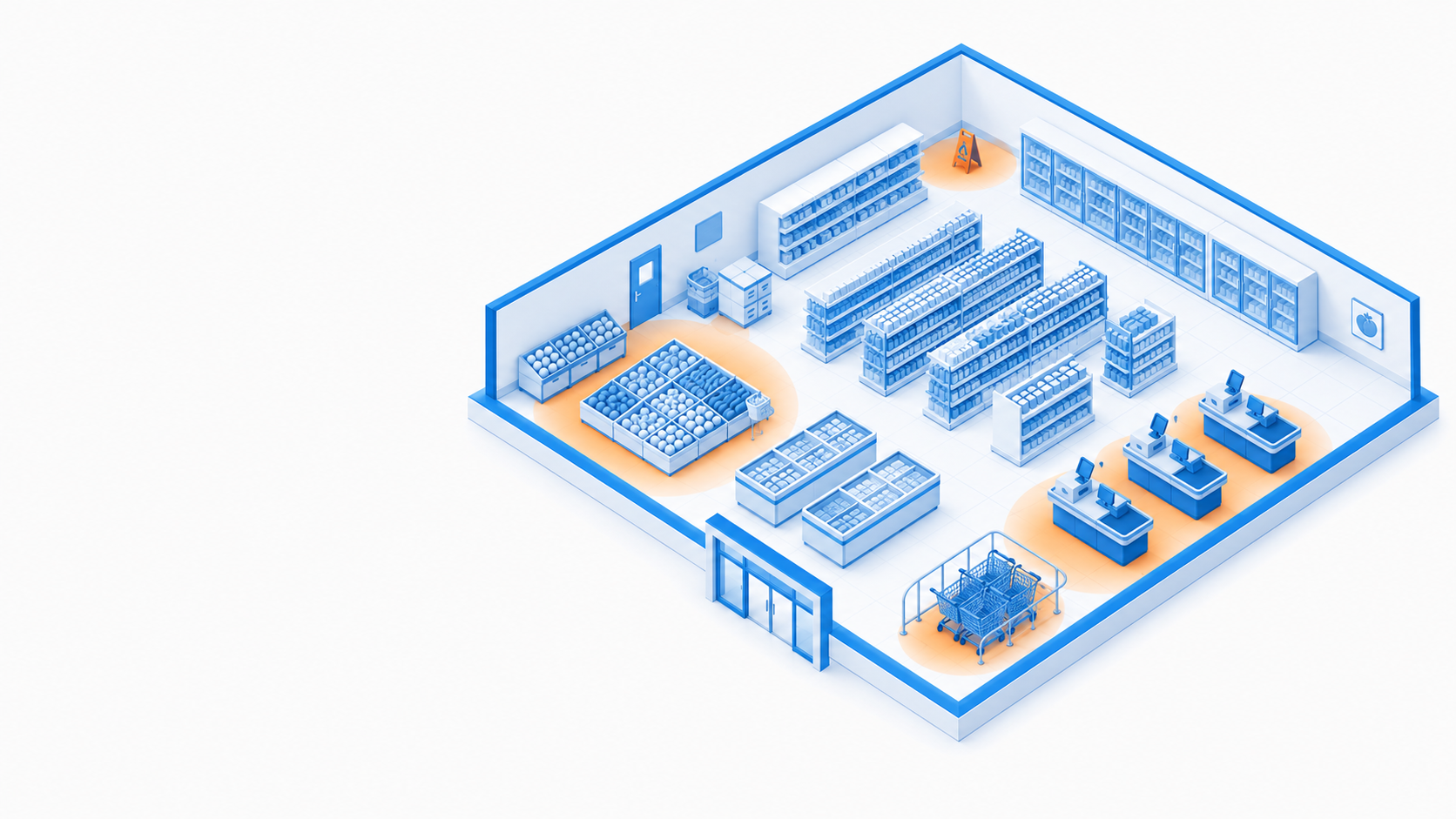
Grocery has one of the highest slip-and-fall rates in retail. Wet produce departments, condensation, and high-traffic checkout lanes create constant exposure. Here is the full prevention and incident response framework.
Few work environments create slip-and-fall exposure quite like a grocery store. Walk the floor and the hazards are everywhere and constant: produce misters leaving puddles, condensation pooling near refrigerated cases, spills in every aisle, mopped floors during business hours, rain tracked in at the entrance, and the relentless foot traffic of checkout lanes. A grocery store is, in effect, a building engineered to keep floors wet and busy at the same time, and that combination is exactly what produces falls.
It is not a minor problem. Falls on the same level are the second leading cause of serious workplace injury in the country, behind only overexertion, and the stakes for grocers are high because these injuries are both frequent and severe. The good news is that slip-and-fall risk is among the most manageable exposures a grocer has if it is approached as a system rather than a series of one-off fixes. This is the full framework: how to prevent what you can, and how to respond fast and correctly to what you cannot.
Why is grocery so exposed?
The first step is to see the store the way the hazards do. Slip-and-fall risk in a grocery operation is not concentrated in one place; it is distributed throughout the building and occurs all day. The recurring hot zones:
- Produce. Misting systems, dropped and crushed produce, and water on the floor make this one of the wettest, highest-risk departments in the store.
- Entrances and vestibules. Rain and snow tracked in on shoes and cart wheels turn entryways into slick surfaces, especially during weather events.
- Refrigerated and freezer aisles. Condensation, defrost cycles, and ice around cases create slip points that reappear constantly.
- Checkout lanes. High traffic, dropped items, leaking containers, and spills combine with the busiest footfall in the store.
- Bakery and deli. Grease, flour, water, and frequent cleaning create slick floors in tight working spaces.
- Cleaning operations. Mopping and floor maintenance during open hours creates wet floors in the middle of customer and employee traffic.
- Back of house and loading docks. Pallets, ramps, spills, and damaged packaging add trip and slip hazards away from the sales floor.
The lesson in that list is structural: because the hazards are continuous and spread across the store, a one-time fix never solves the problem. A freshly cleaned floor is wet again in an hour. Prevention has to be a running system, owned and maintained every shift, not a one-off project.
The cost of getting it wrong
Slip-and-fall injuries are expensive in ways that hit grocers especially hard, given the industry’s thin margins.
Nationally, falls on the same level account for roughly $10.5 billion in serious-injury costs, ranking second among all causes in the most recent Liberty Mutual Workplace Safety Index. On a per-claim basis, the National Council on Compensation Insurance puts the average workers’ comp claim for falls or slips at around $54,499, above the all-cause average. And severity is the real danger: insurer analyses, including Travelers’ workplace injury research, have found that slips, trips, and falls are the single leading driver of severe claims, those costing $250,000 or more. These are not just bruises. They are fractures, knee and back injuries, and head trauma, and roughly one in five slip and fall injuries keep a worker out for more than a month.
There is a second exposure grocers cannot ignore: the same wet floors that injure employees also injure customers, and a customer slip-and-fall can become a general liability claim with a six-figure settlement. A single wet-floor failure can therefore generate both a workers’ comp claim and a liability claim from the same puddle. Managing slip-and-fall risk effectively protects both sides of the ledger.
The prevention framework
A real prevention program for a grocery store has seven working parts. None of them is exotic; the value is in running all of them, consistently, with clear ownership.
1. Slip-resistant flooring and footwear. Specify slip-resistant flooring or anti-slip treatments in the wettest zones, produce, entrances, deli, bakery, and freezer aisles, and run a mandatory slip-resistant footwear program for employees. Proper footwear alone meaningfully reduces falls, and it is one of the cheapest interventions available.
2. A spill and wet-floor protocol. Establish a clean-as-you-go culture with an immediate spill response: any spill is addressed at once, wet-floor signage goes up, and no wet floor is ever left unattended. Spill stations stocked with absorbent material and signage, placed where spills happen, make the right response the easy response.
3. Entrance management. Use high-quality matting at every entrance, deploy umbrella bags and extra mats during rain and snow, and assign someone to monitor and maintain entryways during weather, when the risk spikes.
4. Refrigeration and condensation control. Maintain case seals and defrost systems so that condensation and ice do not accumulate; use anti-slip mats around refrigerated and freezer zones; and inspect these areas frequently, since the hazard recurs continuously.
5. Housekeeping and sightlines. Keep aisles clear of stocking carts, pallets, and cords, manage clutter in the back of house, and maintain good lighting throughout, since a hazard that cannot be seen cannot be avoided.
6. Training and a reporting culture. Train employees not just on cleanup but on moving safely through wet zones, handling carts and stock, and reporting hazards immediately. The goal is a floor full of people who see and fix hazards, not just a safety manager who inspects once a shift.
7. Scheduled inspections with clear ownership. Run regular floor walks and documented hazard audits, and assign ownership of each zone so that maintaining it is a specific person’s responsibility rather than everyone’s vague concern. Pair this with your own injury data: your OSHA 300 log and incident reports will show you exactly which departments and which times of day generate your falls, so you can fix the source rather than guessing.
That last point is the difference between a program that works and one that just looks busy. Prevention should be aimed at your actual hot zones, identified from your own incident history, and re-aimed as the data changes.
The response framework
No matter how good the prevention, falls will still happen in an environment this wet and busy. What you do in the minutes and days after one determines whether it stays a minor, recoverable event or becomes a severe, expensive claim. The response sequence:
1. Immediate clinical care. The first move is to quickly get the injured worker assessed by a clinician, not default them to the emergency room, and not wave it off. Fast, appropriate clinical contact prevents a large share of slip-and-fall injuries from escalating, keeps them medical-only where possible, and sets the claim on the right trajectory from the start. This matters more for falls than for almost any other injury type, because falls tend to have severe outcomes when mishandled early.
2. Secure and document the scene. Immediately secure the area to prevent a second injury, then document everything: photograph the floor conditions, the cause if visible, and the surroundings, and record witness information. This documentation protects you on both the workers’ comp and the customer-liability sides, where the condition of the floor is the central question.
3. Report and classify correctly. File the incident report promptly, make an accurate OSHA recordability determination, and log it on your 300 if it qualifies. Accurate classification protects your injury rates and your experience rating.
4. Investigate the root cause. Determine why the fall happened and in which zone, then fix the source and feed it back into your prevention program. A fall that recurs in the same spot is a prevention failure you can see coming.
5. Return the worker to suitable duty. Many slip and fall injuries allow for modified or transitional duty during recovery. Getting the worker back to appropriate tasks quickly limits lost time, reduces claim severity, and supports a full recovery.
Where HealthcareLive fits
The two halves of this framework, prevention and response, are exactly where an occupational health partner adds leverage, and the response side is where grocers gain the most, because slip and fall injuries are so severity-sensitive.
HealthcareLive’s same-shift clinical care, through Remote Injury Care and On-Site Programs, puts a clinician in front of an injured worker within minutes of a fall, which helps prevent these severity-prone injuries from escalating into the six-figure claims the data warns about. Its occupational health support keeps your recordkeeping and OSHA classifications accurate, so the slip-and-fall claims on your 300 log reflect reality and your injury rates stay clean. And because that same data identifies your repeat hot zones, it closes the loop on prevention, directing your flooring, footwear, and housekeeping efforts to the departments actually causing your falls. For a grocer, that combination, fast care to control severity and clean data to sharpen prevention, is how slip and fall risk goes from a constant liability to a managed one.
The bottom line
Grocery slip and fall risk is constant by design, because the same operations that keep a store running, misting produce, refrigeration, cleaning, and heavy traffic, keep the floors wet and busy. That makes prevention a daily system rather than a one-time project, and it makes a fast, correct response essential, because falls are among the most severe-prone injuries there are. Build the prevention program around your real hot zones, respond to every fall with immediate clinical care and thorough documentation, and close the loop by targeting prevention based on your own data. If you want help building both halves of that framework, HealthcareLive can help.
Frequently asked questions
Why are slip and falls so common in grocery stores? Grocery operations continually create wet, obstructed floors. Produce misting, refrigeration condensation, spills, in-hours mopping, rain tracked through entrances, and the heavy traffic of checkout lanes all combine to keep floors slick and busy throughout the day. The hazards are distributed across the whole store and regenerate constantly, which is why one-time fixes do not solve the problem.
How much do slip and fall injuries cost? They are among the most expensive workplace injuries. Falls rank on the same level as the second leading cause of serious workplace injury nationally, at roughly $10.5 billion, and the average workers’ comp claim for falls or slips is about $54,499, above the all-cause average. Slips, trips, and falls are also the leading driver of severe claims costing $250,000 or more, and about one in five of these claims keeps a worker out for more than a month.
How do you prevent slips and falls in a grocery store? With a continuous system rather than a one-time effort: slip-resistant flooring and mandatory slip-resistant footwear, an immediate spill and wet-floor protocol, strong entrance matting and weather monitoring, refrigeration and condensation control, disciplined housekeeping and lighting, training and a hazard-reporting culture, and scheduled inspections with clear ownership of each zone. Targeting these efforts at the hot zones identified in your own incident data is what makes them effective.
What should you do when an employee slips and falls? Get them prompt clinical care first, since fast assessment keeps these severity-prone injuries from escalating. Then secure and photograph the scene, gather witness information, file the incident report, make an accurate recordability determination, investigate the root cause and fix it, and return the worker to suitable modified duty as soon as it is appropriate.
Do slips and falls affect workers’ comp costs? Significantly. Because falls skew toward severe, high-cost claims, they are a major driver of claim severity, which flows into your DART rate and your experience modification rate, and therefore your premium. They can also create customer liability exposure from the same hazard. Controlling slip-and-fall risk is one of the higher-leverage cost moves a grocer can make.
Sources and methodology
This article reflects current workplace slip, trip, and fall data, including the 2025 Liberty Mutual Workplace Safety Index ranking falls on the same level as the second leading cause of serious workplace injury at roughly $10.5 billion; National Council on Compensation Insurance data putting the average workers’ comp claim for falls or slips at about $54,499, above the all-cause average of roughly $47,316; Travelers workplace injury research identifying slips, trips, and falls as the leading driver of severe claims of $250,000 or more and roughly 23% of injuries; Bureau of Labor Statistics data on floors, surfaces, and walkways as a major injury source for retail workers; and additional 2025 and 2026 industry safety reporting on slip and fall frequency, lost-time rates, and cost.
The characterization of grocery as having one of the highest slip-and-fall rates in retail reflects the sector’s hazard profile and injury data, rather than a single published ranking. Cost and settlement figures are representative and vary by injury, jurisdiction, and claim. Service descriptions attributed to HealthcareLive, including Remote Injury Care, On-Site Programs, and occupational health recordkeeping support, reflect HealthcareLive’s own program design and network experience.