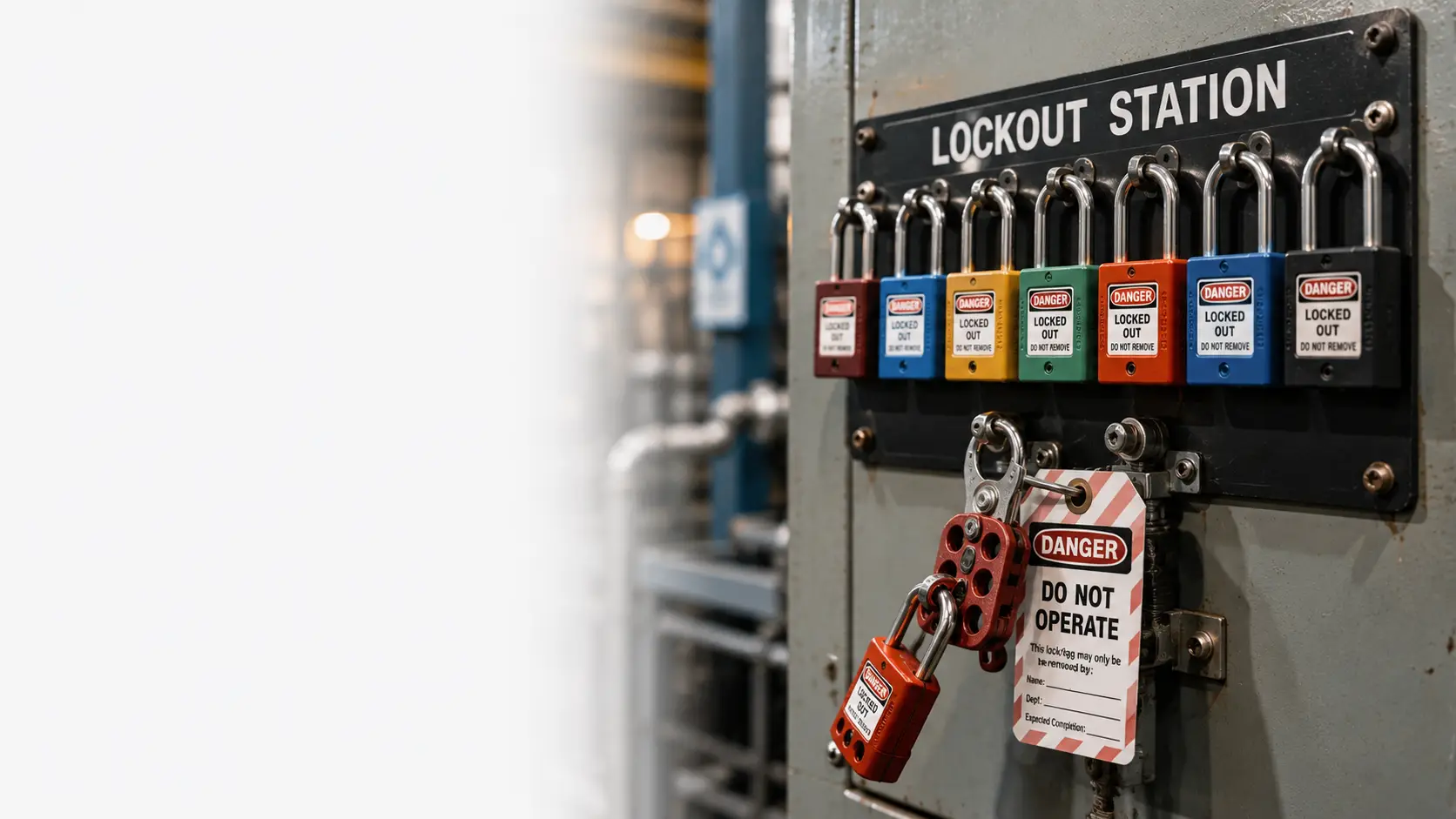
Lockout/tagout is the fourth most-cited OSHA standard and one of the most lethal to get wrong. Here is what 29 CFR 1910.147 requires, the violations OSHA issues citations for most often, and how a real energy-control program prevents injuries.
There is a specific moment when manufacturing turns dangerous in a way that machine guards alone cannot stop: when a worker reaches into a machine to service it, clear a jam, or perform maintenance. In that moment, the guards are often off, and the worker is inside the danger zone, and if the machine is not fully shut down and locked out, an unexpected startup or a release of stored energy can amputate, crush, electrocute, or kill. Controlling that hazard is the entire purpose of lockout/tagout.
About 3 million U.S. workers regularly service or maintain equipment that exposes them to hazardous energy, and OSHA estimates that proper lockout/tagout compliance prevents roughly 120 fatalities and 50,000 injuries every year. Yet the standard remains one of the most frequently cited in the country, ranking fourth on OSHA’s most-cited list in fiscal year 2025 with 2,177 citations. The reason is revealing: most violations are not split-second field mistakes but failures to build and maintain the program in the first place. Here is what the standard requires, where employers go wrong, and how to prevent the injuries.
What lockout/tagout is and why it matters
The Control of Hazardous Energy standard, 29 CFR 1910.147, requires employers to control hazardous energy during the servicing and maintenance of machines and equipment. People think first of electricity, and electrical energy is a major part of it, but the standard covers every form of hazardous energy: mechanical, hydraulic, pneumatic, chemical, thermal, and gravitational, including the stored or residual energy in springs, capacitors, raised parts, and pressurized systems. The danger is unexpected energization or startup, or the release of that stored energy, while a worker is exposed.
The injuries this prevents are the catastrophic ones: caught-in injuries and amputations, crushing, electrocution, and burns. Hazardous energy was associated with roughly 190 deaths in 2023, most of them electrical. And the injuries that are not fatal are still serious, with injured workers losing an average of more than three weeks of work to recover. This is also the standard that makes machine guarding complete, because servicing and maintenance are precisely when guards come off, and lockout protects the worker during that window.
What the standard requires
A compliant program has a defined set of elements, and they are where compliance is won or lost:
- A written energy control program. The overarching program that establishes how the facility controls hazardous energy.
- Machine-specific written procedures. Each piece of equipment with hazardous energy requires its own documented procedure that lists the energy sources and the exact steps to isolate them. Generic, one-size-fits-all procedures do not satisfy the standard.
- Locks and tags. Lockout devices to physically secure energy-isolating devices, with each authorized employee applying their own assigned lock and holding the only key. Tags alone are weaker and allowed only in limited circumstances.
- Training for three groups. Authorized employees who perform lockout, affected employees who operate the equipment, and other employees who work nearby all need training appropriate to their role, and it must be documented and refreshed.
- Periodic inspection. The energy control procedures must be inspected at least annually to confirm they are accurate and being followed.
- Group and shift-change procedures. Defined methods for crews working together and for handing off control across shifts, so protection is never dropped.
Underlying all of it is the application sequence that every authorized employee must follow: notify affected workers, shut down the machine, isolate all energy sources, apply locks and tags, release any stored or residual energy, and then verify a zero-energy state by attempting to start the machine before any work begins. That last step, the try-out, is the one that confirms the worker is actually safe.
The violations OSHA writes up the most often
The pattern in OSHA’s citation data is consistent and instructive. The most frequently cited provisions are not exotic; they are the foundations of the program:
- Missing or generic energy control procedures. The single most-cited provision. Employers either have no written, machine-specific procedures or rely on a generic document that does not address the actual equipment. This is the number one citation by a wide margin.
- Training and communication gaps. Employees are not trained, not trained for their specific role, or have no documentation of the training.
- Skipped periodic inspections. The required annual audit of procedures is not performed, so no one catches when a procedure has drifted out of date.
- Application of control failures. The lockout steps were not followed in the required sequence.
To those documented citations, add the field failures inspectors find again and again: skipping the zero-energy verification, addressing only electrical power while ignoring pneumatic, hydraulic, mechanical, or stored energy, and employees not using their own individual locks. The takeaway is important: because the top citations are program-documentation failures, most LOTO violations reflect a program that was never fully built, not a single worker’s bad day. That is good news, because it means the fix is largely within the employer’s control.
How a real program prevents injuries
Preventing lockout injuries means closing exactly the gaps OSHA cites:
- Write a machine-specific procedure for each piece of equipment that contains hazardous energy. This is the foundation and the most common gap. Each procedure should list all energy sources and the precise isolation steps.
- Account for all energy types, not just electricity. Map the pneumatic, hydraulic, mechanical, thermal, chemical, and gravitational energy on each machine, including stored energy that must be released or restrained.
- Train all three employee groups and document it, then retrain when equipment or processes change.
- Perform the annual inspection and use it to keep procedures accurate as equipment evolves.
- Enforce individual locks and the zero-energy verification. Each authorized worker uses their own lock, and no one begins work until the try-out confirms zero energy.
- Handle group and shift-change scenarios using defined procedures to ensure control is never lost during handoffs.
- Hold a hard line against shortcuts. Lockout fails in high-pressure, hands-on moments, when a quick jam clearance feels faster than a full lockout. The culture has to make the shortcut unacceptable because that is when the injury occurs.
One nuance worth understanding so it is not misused: the standard includes a minor servicing exception for routine, repetitive tasks that are integral to production, but only when alternative protective measures provide effective protection. It is a narrow exception, not a general permission to skip lockout, and OSHA reads it narrowly.
The cost of getting it wrong
The injuries lockout prevents are among the most severe and expensive there are: amputations averaging roughly $125,000 in workers’ comp cost and far more over a lifetime, electrocutions, and fatalities. On top of the human and claim costs, the penalties are steep: OSHA serious violations exceed $16,000 each and willful or repeat violations exceed $165,000, with the maximums adjusting each January upward, and willful or repeat lockout citations frequently draw the maximum. A pattern of them can land an employer in the Severe Violator Enforcement Program. And because OSHA’s renewed Amputations emphasis program inspects specifically for lockout/tagout and machine guarding, manufacturers in covered industries face a real likelihood of having their program examined.
Where HealthcareLive fits
The energy-control procedures and lockout discipline that prevent these injuries are programs an employer builds and enforces on its own equipment. Where HealthcareLive adds value is around the injury and the compliance obligations that follow.
When a hazardous-energy incident causes a serious injury, immediate clinical response matters for the outcome, and HealthcareLive’s same-shift care through Remote Injury Care and On-Site Programs puts expert help in front of the worker in the critical first minutes. Its occupational health support handles the recordkeeping and mandatory OSHA reporting following a serious injury or amputation, along with the return-to-work and modified-duty plan for the recovering worker. And for the broader population of maintenance and servicing injuries that are not catastrophic, fast on-site care keeps them from escalating, while incident data points back to the equipment and tasks that need attention. The lockout program prevents catastrophic injury; HealthcareLive manages the medical response, compliance reporting, and recovery efforts.
The bottom line
Lockout/tagout protects workers in the single most dangerous moment in manufacturing, the moment someone reaches into a machine. The standard is detailed but not mysterious, and the violations OSHA most often cites are the basic ones: no machine-specific procedures, no documented training, no annual inspection. That means compliance is largely a matter of building the program properly and refusing to allow shortcuts. Given that it is the fourth most-cited standard, an enforcement focus of the Amputations emphasis program, and a barrier against some of the most catastrophic injuries and penalties in the industry, lockout/tagout is one of the highest-stakes programs a manufacturer runs. Build it fully, and have a fast medical and compliance response ready for anything that still goes wrong. HealthcareLive can help with that side of it.
Frequently asked questions
What is lockout/tagout? Lockout/tagout, governed by OSHA standard 29 CFR 1910.147, is the practice of controlling hazardous energy during the servicing and maintenance of machines to prevent them from unexpectedly starting up, energizing, or releasing stored energy while a worker is exposed. It covers electrical, mechanical, hydraulic, pneumatic, thermal, chemical, and gravitational energy.
What does OSHA 1910.147 require? A written energy control program, machine-specific written procedures for every piece of equipment with hazardous energy, lockout devices with each authorized worker using an individual lock, training for authorized, affected, and other employees, at least annual inspection of the procedures, and defined group and shift-change procedures. Workers must follow a set sequence that ends with verification of a zero-energy state before beginning work.
What is the most common lockout/tagout violation? Failing to develop and document machine-specific energy control procedures. Employers are most often cited for having no written procedures or for using generic ones that do not address the specific equipment. Training gaps and skipped annual inspections are the next most common.
How many injuries does lockout/tagout prevent? OSHA estimates that proper compliance prevents roughly 120 fatalities and 50,000 injuries each year. Roughly 3 million workers regularly service equipment exposed to hazardous energy, and those who are injured lose an average of more than three weeks of work.
What is the minor servicing exception? A narrow exception for routine, repetitive tasks integral to production, which are exempt from full lockout only when alternative measures provide effective protection. It is not a general permission to skip lockout, and OSHA interprets it narrowly, so employers should be cautious about relying on it.
What are the penalties for lockout/tagout violations? OSHA serious violations exceed $16,000 each, and willful or repeat violations exceed $165,000, with maximums adjusting upward annually for inflation. Willful and repeat lockout citations frequently draw the maximum penalty, and a pattern can lead to placement in the Severe Violator Enforcement Program.
Sources and methodology
This guide reflects current OSHA standards and enforcement data, including 29 CFR 1910.147 (the Control of Hazardous Energy / lockout-tagout standard); its ranking as the fourth most-cited OSHA standard in fiscal year 2025 with 2,177 citations; the OSHA estimate that compliance prevents roughly 120 fatalities and 50,000 injuries annually; the estimate that about 3 million workers regularly service equipment exposed to hazardous energy; data indicating injured workers lose an average of more than three weeks of work; and the most-cited provisions of the standard, which center on missing or generic energy control procedures, training, and periodic inspection. The relationship to the Amputations emphasis program reflects OSHA directive CPL 03-00-027.
OSHA penalty maximums are stated as approximate because they are adjusted each January for inflation; verify the current year’s amounts at osha.gov before citing them in a compliance document. The amputation cost figure is an average and varies by injury, body part, jurisdiction, and claim. Service descriptions attributed to HealthcareLive, including Remote Injury Care, On-Site Programs, and occupational health support, reflect HealthcareLive’s own program design and network experience. This content is informational and is not legal or medical advice.