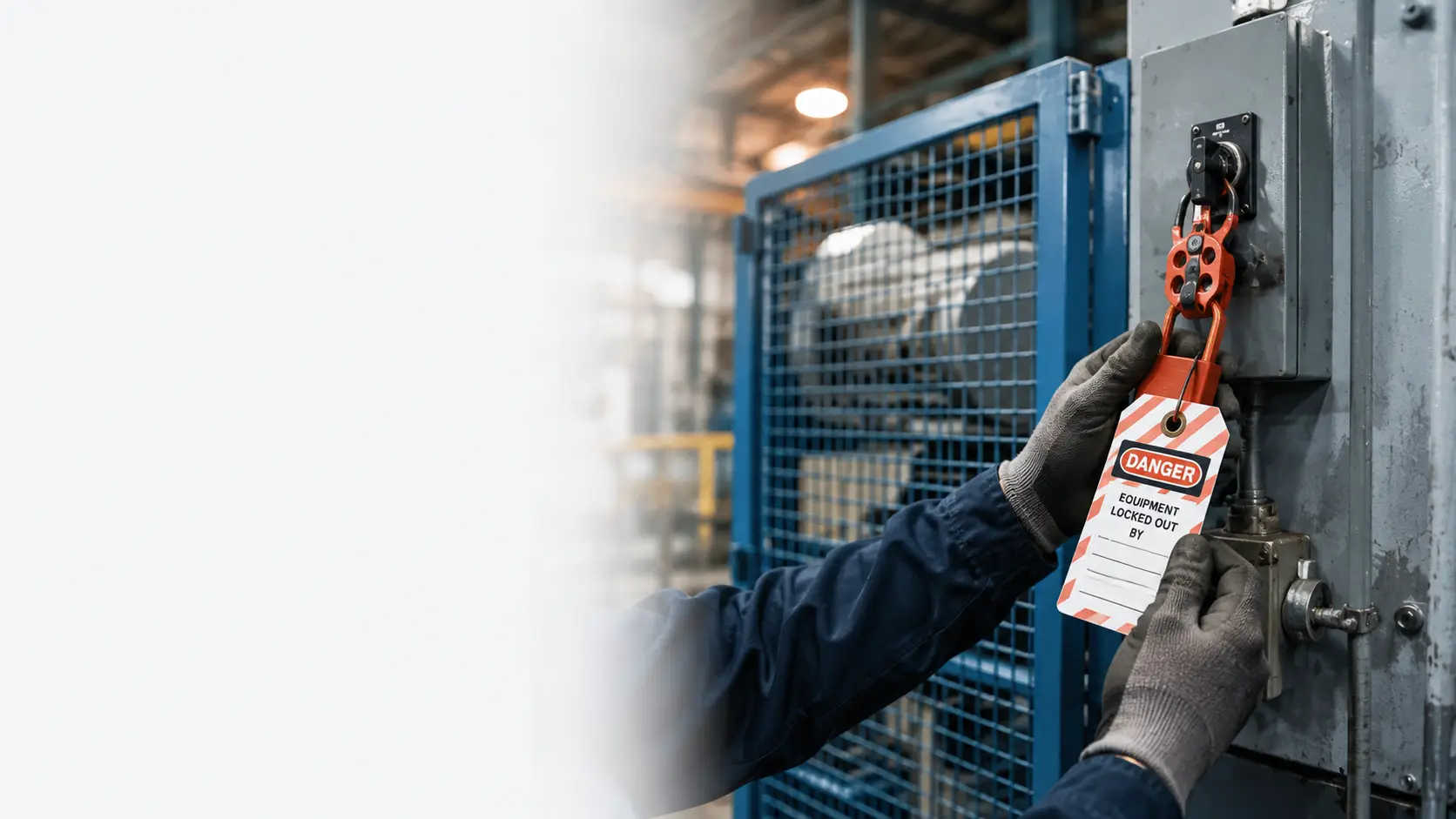
An amputation is the most catastrophic and preventable injury on the plant floor. Here is what the OSHA machine guarding standard requires, why lockout matters as much as the guard, and what a caught-in injury actually costs.
Of all the injuries that happen in manufacturing, the caught-in injury is the one that changes a life in an instant. A hand pulled into a set of rollers, an arm caught in a press, fingers lost to an unguarded blade: these are not the most frequent injuries on the floor, but they are the most severe, and they are almost always preventable. OSHA’s own enforcement history is blunt about the cause: workers are injured when machinery is not properly guarded or maintained, or when hazardous energy is not controlled.
Two things prevent nearly every one of these injuries: a guard that keeps the body out of the danger zone and an energy-control procedure that ensures the machine is off before anyone reaches into it. Two OSHA standards govern them, both sit among the most-cited in the country, and OSHA has made amputations a standing enforcement priority. Here is what the rules require, how to actually prevent these injuries, and what one costs when prevention fails.
The OSHA machine guarding standard
The core requirement lives in 29 CFR 1910.212, the general machine guarding standard. Its principle is simple: one or more methods of machine guarding must protect operators and other workers from the hazards created by a machine, including the point of operation, ingoing nip points, rotating parts, and flying chips or sparks. The point of operation, where the machine actually does its work on the material, gets specific attention because that is where hands and fingers are most often lost.
The standard recognizes several ways to achieve protection. Fixed guards are barriers that physically prevent contact. Interlocked guards shut the machine down if the guard is opened. Adjustable and self-adjusting guards accommodate different stock sizes while still blocking access. And safeguarding devices, such as presence-sensing systems and two-hand controls, stop or prevent operation when a worker is in the danger zone. Several companion standards cover specific equipment, including 1910.213 for woodworking machinery, 1910.217 for mechanical power presses, and 1910.219 for power-transmission apparatus.
This is not an obscure rule. Machine guarding is consistently among OSHA’s ten most-cited standards, ranking number ten in fiscal year 2024, which tells you both how common guarding gaps are and how routinely OSHA writes them up.
Why lockout/tagout matters as much as the guard
Here is the detail that surprises many employers: a large share of amputations do not happen during normal operation at all. They happen during servicing, maintenance, and clearing a jam, the moments when the guard is off, and a worker reaches into the machine. If the machine is not fully de-energized and locked out, an unexpected start or a release of stored energy in that instant is what takes the hand.
That is why the Control of Hazardous Energy standard, 29 CFR 1910.147, known as lockout/tagout, is the essential partner to machine guarding. It requires machine-specific procedures to isolate and de-energize equipment before service, so it cannot start while someone is inside the point of operation. Lockout/tagout is the third most-cited OSHA standard, ranking even higher than machine guarding in fiscal year 2024. The two work as a pair: guards protect during operation, lockout protects during everything else. An amputation-prevention program that addresses one but not the other has left the door open.
OSHA’s renewed Amputations emphasis program
OSHA does not leave these standards to chance. In June 2025, it renewed its National Emphasis Program on Amputations in Manufacturing Industries under directive CPL 03-00-027, a five-year program that replaced the prior version. The NEP directs OSHA’s offices to conduct programmed inspections of manufacturers operating machinery capable of causing amputations, focusing on the same five standards: lockout/tagout, general machine guarding, woodworking machinery, power presses, and power-transmission equipment.
The targeting is data-driven. OSHA identified more than 90 manufacturing NAICS codes for inclusion, drawn from sectors with high amputation counts and a history of guarding and energy-control violations, including meat and poultry processing, bakeries, and wood, plastics, and metal manufacturing. If your operation falls under a covered code, a programmed inspection is a real possibility, and because guarding and lockout gaps are so common, an inspection frequently results in one or more citations. The financial exposure escalates from there: repeat and willful violations run into the six figures each, and a pattern of them can land an employer in OSHA’s Severe Violator Enforcement Program.
The real cost of a caught-in injury
The human cost of an amputation is the part no spreadsheet captures: surgery, often a lifetime of prosthetics and their ongoing replacement and maintenance, chronic pain, the psychological toll, and for major amputations, permanent disability that ends a career.
The financial cost is enormous and long-tailed. The National Safety Council’s assessment of workers’ comp data puts the average payout for an amputation at roughly $125,000, and that average understates the real exposure because major amputations entail lifetime medical care, prosthetic costs that recur for decades, and, in serious cases, permanent disability benefits that mean lifetime payments. A single amputation can drive up a manufacturer’s claim severity, increase its experience modification rate, and create third-party or civil litigation exposure on top of the comp claim. Add the OSHA penalties, which exceed $16,000 per serious violation and $165,000 per willful or repeat violation, and adjust upward every January, and the total dwarfs the cost of the guard that would have prevented it.
There is also a reporting obligation people forget in the chaos of the moment: under 29 CFR 1904.39, an employer must report any work-related amputation to OSHA within 24 hours. Failing to do so is its own violation.
How to prevent it
Amputation prevention is a program, not a poster. The components:
- Assess every machine. Walk each piece of equipment and identify every hazard: the point of operation, nip points, rotating parts, and any place a body part can reach a moving component. You cannot guard what you have not identified.
- Install the right guard or device. Match the safeguard to the machine, fixed or interlocked guards, presence-sensing devices, and two-hand controls, so the danger zone cannot be reached while the machine runs.
- Run a disciplined lockout/tagout program. Write machine-specific energy-control procedures, supply locks and tags, and enforce full de-energization before any servicing, maintenance, or jam clearing. This is where the highest-severity injuries are won or lost.
- Train operators and maintenance separately. Operators need to know the guards and never bypass them; maintenance workers need the lockout procedures cold, because they are the ones reaching inside.
- Audit and never tolerate a bypass. Guards get removed for convenience and not replaced, and production pressure tempts workers to clear a jam without locking out. Routine audits and a hard cultural line against bypassing controls are what keep the program real.
- Plan the emergency response. Know in advance how an injured worker gets immediate care, how the limb is preserved if reattachment is possible, and who makes the 24-hour OSHA report.
Where HealthcareLive fits
The guards and lockout procedures that prevent an amputation are engineering controls that an employer puts on its own machines. HealthcareLive adds value in everything surrounding the injury and the broader machine-contact hazards on the floor.
When a machine injury happens, from a serious laceration to a traumatic amputation, immediate clinical response matters enormously for the worker’s outcome, and HealthcareLive’s same-shift care through Remote Injury Care and On-Site Programs puts expert help in front of the worker in the critical first minutes. Its occupational health support handles the part employers often fumble under stress: accurate OSHA recordkeeping and the mandatory 24-hour amputation report, plus the return-to-work and modified-duty plan that supports a recovering worker. And for the far more common machine-contact injuries, the cuts and lacerations that happen daily, fast on-site care keeps them from escalating, while incident data points back to the machines and tasks generating them. The guards prevent the catastrophic injury; HealthcareLive manages the medical response, compliance obligations, and recovery efforts.
The bottom line
The caught-in injury is the plant floor’s worst-case event and its most preventable one. The path to preventing it is well marked: guard every hazard under 1910.212, control hazardous energy under 1910.147, and recognize that OSHA is actively inspecting for both under a renewed five-year emphasis program. The cost of getting it wrong, a roughly $125,000 average claim that can run far higher, six-figure penalties, litigation, and a worker’s life permanently altered, makes the economics of prevention overwhelming. Guard the machines, lock out the energy, train the people, and have a fast medical and reporting response ready for the day something still goes wrong. If you want help building the response and compliance side of that, HealthcareLive can help.
Frequently asked questions
What does OSHA’s machine guarding standard require? Under 29 CFR 1910.212, employers must use one or more guarding methods to protect workers from machine hazards, including the point of operation, nip points, rotating parts, and flying chips. Acceptable methods include fixed and interlocked guards, adjustable guards, and safeguarding devices such as presence-sensing systems and two-hand controls. Specific equipment is covered by companion standards for woodworking machinery, power presses, and power-transmission apparatus.
What is OSHA’s Amputations National Emphasis Program? It is a targeted enforcement program, renewed in June 2025 under directive CPL 03-00-027 for five years, under which OSHA conducts programmed inspections of manufacturers operating machinery that can cause amputations. It covers more than 90 manufacturing NAICS codes and focuses on machine guarding and lockout/tagout compliance. Operations in covered codes face a real likelihood of inspection and citation.
Why is lockout/tagout important for preventing amputations? Because a large share of amputations occur during servicing, maintenance, and jam clearing, when guards are off, and a worker reaches into the machine. If the equipment is not fully de-energized and locked out, an unexpected start or release of stored energy can cause amputation. Lockout/tagout, the most-cited of these standards, prevents exactly that.
How much does an amputation cost an employer? The National Safety Council puts the average workers’ comp payout at roughly $125,000, but major amputations cost far more over time due to lifetime medical care, recurring prosthetic costs, and permanent disability benefits. Add OSHA penalties exceeding $16,000 per serious and $165,000 per willful or repeat violation, potential litigation, and the effect on the employer’s experience modification rate, and the full cost is far higher than the guard that would have prevented it.
Do I have to report an amputation to OSHA? Yes. Under 29 CFR 1904.39, a work-related amputation must be reported to OSHA within 24 hours. A work-related fatality must be reported within 8 hours. Failing to report on time is itself a violation.
Sources and methodology
This guide reflects current OSHA standards and enforcement, including 29 CFR 1910.212 (machine guarding), 1910.147 (control of hazardous energy / lockout-tagout), and the companion standards 1910.213, 1910.217, and 1910.219; the renewal of the National Emphasis Program on Amputations in Manufacturing Industries on June 26, 2025, under directive CPL 03-00-027, a five-year program covering more than 90 manufacturing NAICS codes; rankings showing lockout/tagout and machine guarding as the third and tenth most-cited OSHA standards in fiscal year 2024; the OSHA reporting requirement under 29 CFR 1904.39 (amputations within 24 hours, fatalities within 8 hours); and the National Safety Council’s assessment of workers’ compensation data indicating an average amputation payout of roughly $125,000.
OSHA penalty maximums are stated as approximate because they are adjusted each January for inflation; verify the current year’s amounts at osha.gov before citing them in a compliance document. Claim and cost figures are averages and vary widely by injury severity, body part, jurisdiction, and claim. Service descriptions attributed to HealthcareLive, including Remote Injury Care, On-Site Programs, and occupational health support, reflect HealthcareLive’s own program design and network experience. This content is informational and is not legal or medical advice.