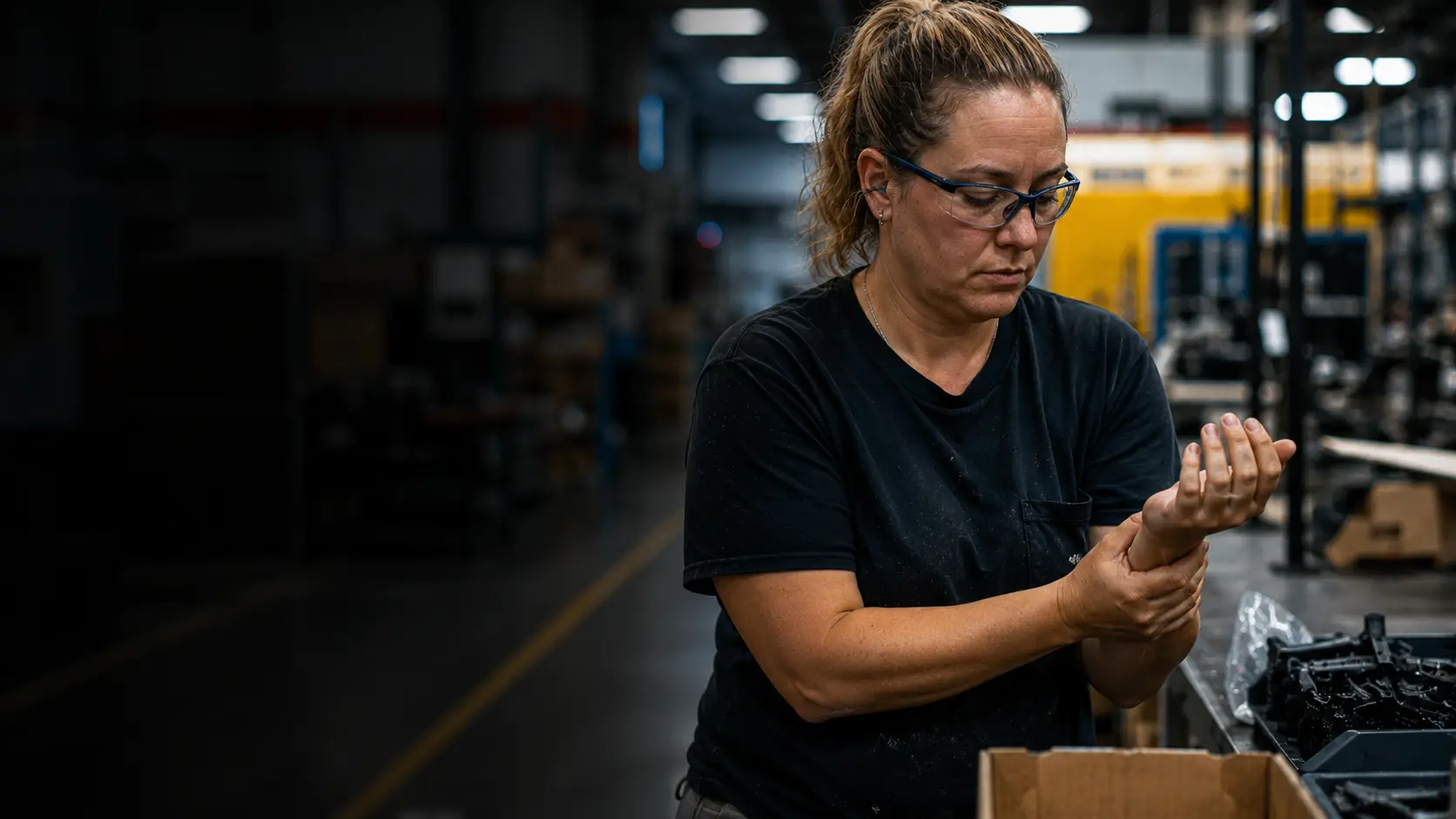
Cumulative trauma injuries develop too slowly to notice and cost more than you would expect, including carpal tunnel claims that keep workers out longer than an amputation. Here is why these slow-motion injuries quietly inflate your experience mod, and how to stop them.
Cumulative trauma is the injury you never see coming because it does not happen in a single moment. Unlike a laceration or a fall, repetitive strain and cumulative trauma disorders build up slowly, over months and years of the same motion, until a worker can no longer grip a tool, feels numbness at night, or cannot get through a shift without pain. There is no dramatic accident to investigate, which is exactly why these injuries get ignored until they are chronic.
That slow, quiet onset hides a sharp financial edge. Cumulative trauma injuries are among the most expensive injury categories in manufacturing, and they do something most injuries do not: they quietly inflate your experience modification rate, the multiplier that drives your workers’ comp premium. Here is what these injuries are, why they cost more than they appear to, why they hit your mod so hard, and how to stop them.
What cumulative trauma injuries are
Cumulative trauma injuries are gradual-onset damage to muscles, tendons, and nerves caused by sustained exposure to physical stress rather than a single event. The usual culprits are repetition, high force, awkward or static posture, and vibration, often in combination.
The conditions are familiar names. Carpal tunnel syndrome, tendinitis, lateral and medial epicondylitis (tennis and golfer’s elbow), rotator cuff disorders, trigger finger, De Quervain’s tenosynovitis, and bursitis are all cumulative trauma disorders, along with many gradual-onset back conditions.
A quick note on terminology helps here. The older labels, repetitive strain injury and cumulative trauma disorder, have largely been folded into the broader umbrella term musculoskeletal disorder, or MSD, which agencies like NIOSH now prefer. Cumulative trauma refers specifically to the gradual-onset subset of MSDs, the ones that develop over time rather than in an instant.
What makes them insidious is precisely that slow development. Because there is no single triggering event, workers dismiss early symptoms, the link to the job is easy to dispute, and the condition is often well advanced, sometimes requiring surgery, before anyone treats it as a workplace injury.
Why the slow-motion injury costs more than it looks
Here is the counterintuitive part. The injuries that look minor on the surface are some of the most expensive in terms of recovery time. Carpal tunnel syndrome has historically ranked among the conditions with the highest median number of days away from work for any injury or illness. BLS data has put carpal tunnel around 28 days away, compared with roughly 22 days for amputations and about 8 days for injuries overall.
Read that again: a carpal tunnel claim can keep a skilled worker out longer than an amputation. Repetitive-motion injuries broadly run well above the all-injury median, and the workers’ comp cost of a carpal tunnel claim commonly ranges from $20,000 to $100,000 once it reaches surgery and extended recovery.
Multiply that across a workforce, and the scale is enormous. Musculoskeletal disorders account for roughly one out of every three workers’ compensation dollars and more than $20 billion in direct comp costs each year. The cumulative trauma subset is a large share of that, and because these injuries are frequently underreported until they are severe, the claims that do surface tend to be the expensive, advanced ones.
There is a hidden cost beyond the claim itself. The workers who develop these injuries are often the experienced, high-output employees who have performed the same skilled task for years, so losing one to a months-long recovery means losing institutional knowledge and productivity that a new hire cannot immediately replace.
Why cumulative trauma inflates your experience mod
This is where cumulative trauma does its quietest damage. Your experience modification rate compares your actual losses to the expected losses for your industry class, and the way it is calculated makes cumulative trauma uniquely punishing. Three mechanics drive it.
First, your mod weights frequency more heavily than severity. Through the primary and excess loss split, the calculation counts the first portion of every claim in full while discounting the large excess amounts, so several moderate claims raise your mod more than a single catastrophic one of the same total value. Cumulative trauma injuries arrive in numbers, multiple workers on the same repetitive task, and recurring in the same individuals, which is exactly the frequency pattern the mod penalizes.
Second, these are lost-time claims, not medical-only ones. The long recovery times push cumulative trauma claims out of the cheap, lightly weighted medical-only category and into the expensive indemnity category that hits your mod hardest.
Third, they linger. Cumulative trauma claims stay open with large reserves, recur after return to work, and keep your loss runs elevated for years. The result is that a cluster of seemingly minor repetitive injuries can inflate your experience mod more than one dramatic accident, and because the mod multiplies every premium dollar you pay and can disqualify you from bids and contracts, that inflation is expensive in ways that reach well beyond the claims themselves. If you want the full mechanics, see the guide on how to read and lower your EMR.
How to stop cumulative trauma
Because these injuries are built by exposure over time, they respond to two levers, and the highest-return one is often overlooked.
The first lever is engineering the exposure down. This is the ergonomics work of reducing the force, repetition, awkward posture, and vibration in a job through workstation redesign, better tools, job rotation, and built-in recovery time. The dedicated guide on production-line ergonomics covers that process in depth.
The second lever, and the one that matters most for cumulative trauma specifically, is catching it early. Because these injuries develop slowly, there is a long window during which a developing problem can be resolved with simple conservative care before it becomes chronic or surgical. Capturing that window requires a culture where workers report early discomfort without fear, and fast access to clinical care when they do. The economics are stark: an early cumulative trauma complaint is often resolved with a workstation adjustment, a brief course of therapy, and a few modified-duty days, while the same complaint ignored for months becomes a carpal tunnel release and a claim that keeps the worker out for a month or more.
The early warning signs are specific and worth training supervisors to recognize: tingling or numbness in the fingers, aching or weakness in the grip, pain that lingers after the shift or wakes a worker at night, and swelling or stiffness in the wrist, elbow, or shoulder. When those signs are reported and acted on quickly, the outcome is usually a fast recovery; when they are pushed through and ignored, they become chronic surgical claims that drive costs.
Where HealthcareLive fits
Cumulative trauma is the exact problem HealthcareLive’s model is built to solve, because it lives or dies on early intervention. The slow onset that makes these injuries so costly also creates an opportunity to catch them if clinical access is available.
HealthcareLive’s Remote Injury Care and On-Site Programs put a clinician in front of a worker at the first sign of numbness, tingling, or persistent ache, which is exactly when a cumulative trauma injury is cheapest and easiest to resolve. Virtual MSK Care delivers the structured conservative treatment that resolves most of these conditions without surgery and returns workers to full duty faster. And the Stretch and Flex program conditions workers to reduce the frequency of cumulative trauma injuries in the first place. Because every cumulative trauma injury kept early, medical-only, and out of the lost-time category is one less claim feeding the frequency that inflates your mod, this approach attacks the cost at its financial root. It works alongside your prevention efforts on the most common plant-floor injuries.
The bottom line
Cumulative trauma is the slow-motion injury that punishes employers twice: once in recovery time that can exceed an amputation, and again in an experience mod that climbs quietly as these frequent, lingering, lost-time claims accumulate. The injuries look minor right up until they become surgical and expensive.
The defense is a combination of engineering the repetition out of the work and, above all, catching the early symptoms before they become chronic. Build the ergonomics, build the early-reporting culture, and give workers fast access to care, and you take out both the human toll and the mod inflation. If you want help with the early intervention and conservative care that makes the difference, HealthcareLive can help.
Frequently asked questions
What is a cumulative trauma injury? A cumulative trauma injury is gradual-onset damage to muscles, tendons, or nerves caused by sustained repetition, force, awkward posture, or vibration rather than a single event. Because it develops slowly over months or years, it is often well advanced before it is recognized as a workplace injury. It is the gradual-onset subset of musculoskeletal disorders.
What are examples of repetitive strain injuries? Common examples include carpal tunnel syndrome, tendinitis, lateral and medial epicondylitis (tennis and golfer’s elbow), rotator cuff disorders, trigger finger, De Quervain’s tenosynovitis, and bursitis, as well as many gradual-onset back conditions. They are common in manufacturing roles involving repetitive hand and arm work, forceful gripping, or vibrating tools.
How long do workers miss for carpal tunnel? A long time relative to other injuries. Carpal tunnel syndrome has historically ranked among the conditions with the highest median days away from work, around 28 days in BLS data, compared with roughly 22 days for amputations and about 8 days for all injuries combined. Surgical cases and extended recovery can run much longer.
Why do cumulative trauma injuries raise your experience mod? Because of how the mod is calculated. It weighs claim frequency more than severity, and cumulative trauma injuries come in numbers and recur. Their long recovery times make them costly lost-time claims rather than cheap medical-only ones, and they stay open with reserves for years. A cluster of these injuries can raise your mod more than a single severe accident.
How do you prevent repetitive strain injuries? With two approaches together: engineering the exposure down through ergonomics, reducing force, repetition, awkward posture, and vibration with workstation redesign, better tools, job rotation, and recovery time, and catching injuries early through a discomfort-reporting culture and fast access to clinical care before a developing problem becomes chronic or surgical.
Can repetitive strain injuries be treated without surgery? In most cases, yes, especially when caught early. Structured conservative care, including activity modification, ergonomic changes, and physical therapy, resolves the majority of cumulative trauma injuries. The key is early intervention, because a condition addressed at the first symptoms is far more likely to resolve conservatively than one left to advance for months.
Sources and methodology
This guide reflects current data on musculoskeletal and cumulative trauma disorders, including Bureau of Labor Statistics injury and illness data showing carpal tunnel syndrome among the conditions with the highest median days away from work (around 28 days, compared with roughly 22 for amputations and 8 for all injuries); National Safety Council and BLS figures of 937,620 musculoskeletal disorder days-away or restricted cases in private industry in 2023 to 2024; estimates that musculoskeletal disorders account for roughly one in three workers’ compensation dollars and more than $20 billion in direct comp costs annually; and carpal tunnel workers’ comp claim costs commonly ranging from $20,000 to $100,000. Ergonomic and prevention guidance reflects OSHA ergonomics resources and NIOSH guidance, and additional context comes from the National Safety Council’s Injury Facts. Experience modification mechanics reflect standard NCCI rating methodology.
Median days-away figures vary by year and reporting period, and BLS now reports nonfatal days-away data biennially. Cost figures are averages and vary by case, jurisdiction, and severity. Service descriptions and outcomes attributed to HealthcareLive, including Remote Injury Care, On-Site Programs, Virtual MSK Care, and Stretch and Flex, reflect HealthcareLive’s own program design and network experience. This content is informational and is not legal or medical advice.