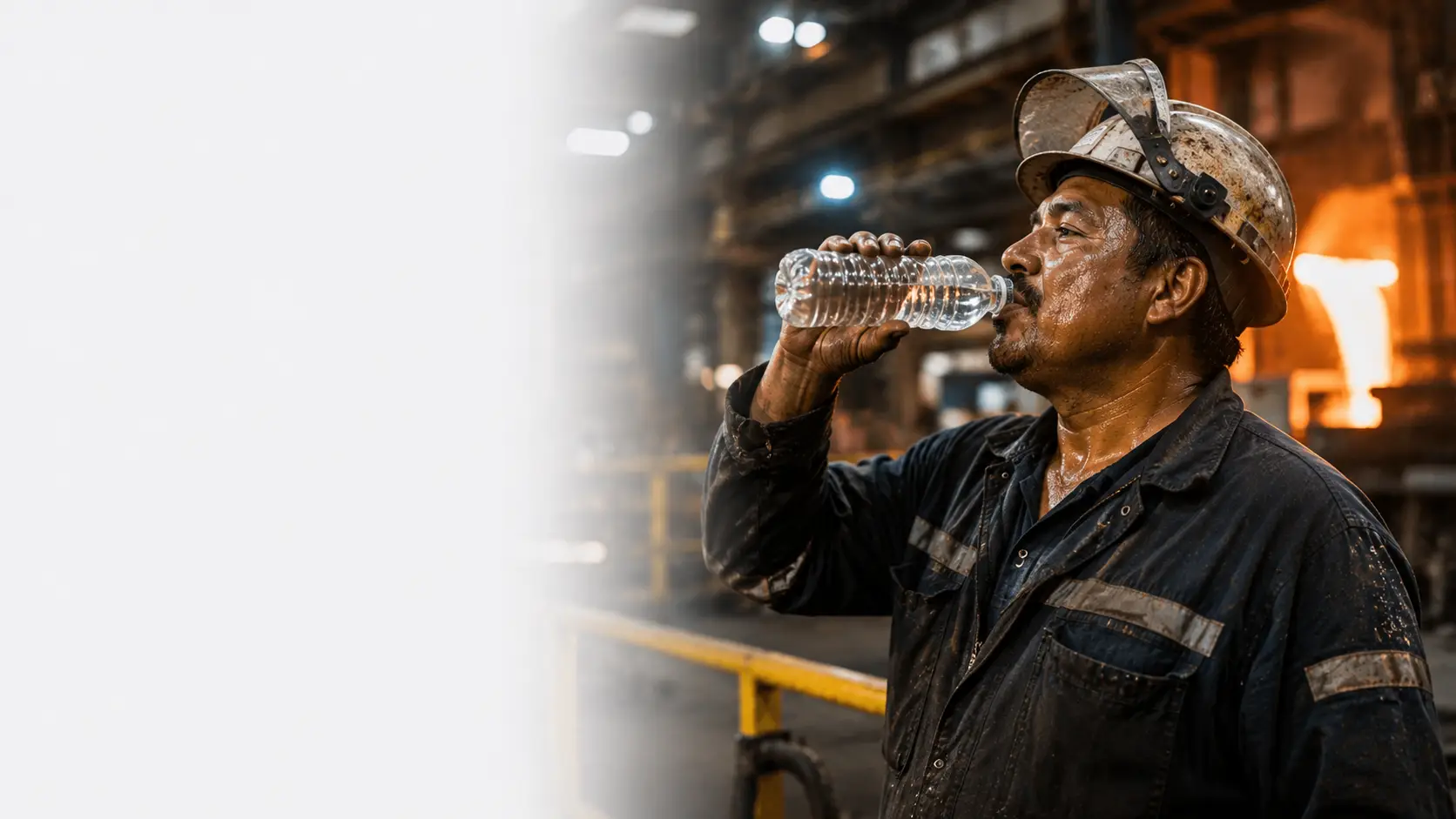
Heat stress is a serious and growing hazard inside manufacturing plants, not just outdoors. Here is how to prevent it, where OSHA’s enforcement stands in 2026, and when a heat illness becomes recordable.
Heat stress is one of the most underestimated hazards on a plant floor, because most people picture heat illness as an outdoor problem. It is not. Foundries, forging operations, glass and plastics plants, bakeries, and warehouses without air conditioning generate dangerous indoor heat that can rival even the outside heat, and unlike the weather, the heat sources inside a plant run year-round.
The stakes are high. Heat-related illness is the leading cause of weather-related death in the United States, and on the job, dozens of workers die and thousands more fall ill from heat each year, figures that safety experts widely consider undercounts. The regulatory landscape around heat stress also shifted in 2026, in ways every manufacturer should understand. Here is how to prevent heat stress on the plant floor, where OSHA’s enforcement actually stands, and when a heat illness has to go on your log.
What heat stress does to the body
Heat stress occurs when the body cannot shed heat quickly enough to maintain a safe core temperature. It progresses along a spectrum, and the speed of that progression is what makes it dangerous.
It often starts with heat rash and heat cramps, then progresses to heat exhaustion, characterized by heavy sweating, weakness, nausea, dizziness, and headache. If it continues, it becomes heat stroke, a medical emergency in which the body’s cooling system fails, core temperature spikes, and organs begin to shut down. Heat stroke can kill within minutes and demands immediate cooling and emergency care.
Indoor manufacturing has specific heat-stress risk multipliers. Radiant heat from furnaces, ovens, and machinery, high humidity from processes and washdowns, heavy physical exertion, and personal protective equipment that traps heat all push workers toward the dangerous end of that spectrum. Individual factors matter too: hydration, age, underlying health conditions, certain medications, and above all, whether the worker is acclimatized to the heat.
OSHA’s heat emphasis program and the stalled standard
This is where employers most need current information, because two separate things are happening at the federal level, and they are easy to confuse.
The first is enforcement, and it is active. OSHA’s Heat National Emphasis Program expired on April 8, 2026, and OSHA immediately revised and expanded it, with an updated directive effective April 10, 2026 that runs for five years. The revised program covers both indoor and outdoor heat and targets roughly 55 high-risk industries, including manufacturing. It operates around the concept of a “Heat Priority Day,” triggered when the local heat index is expected to reach 80°F or higher, and it authorizes proactive inspections, especially when the National Weather Service issues a heat warning or advisory. For a manufacturer with hot indoor processes, that means real heat stress inspection exposure during the warm months.
The second is the proposed federal heat standard, and its status is different. OSHA published a notice of proposed rulemaking on August 30, 2024, titled Heat Injury and Illness Prevention in Outdoor and Indoor Work Settings. The proposed rule would apply across general industry, construction, maritime, and agriculture, and would require a written heat injury and illness prevention plan, a designated heat safety coordinator, heat monitoring, and specific controls at two trigger points: an initial heat trigger at a heat index of 80°F and a high-heat trigger at 90°F.
But the standard has stalled. The public comment period and the informal public hearing concluded in 2025, with the post-hearing period ending October 30, 2025, and as of mid-2026, the rule remains proposed rather than final, with no finalization date set and no clear indication that it is a current priority. The practical message is that employers should not plan around an imminent federal heat standard.
That does not mean heat stress is unregulated. Until any standard is finalized, OSHA enforces heat hazards through the General Duty Clause together with the active emphasis program, and several states, including California, Colorado, Maryland, Minnesota, Nevada, Oregon, and Washington, already have their own enforceable heat standards. The smart approach is to treat the proposed rule’s 80°F and 90°F thresholds as the working benchmark, because they reflect where both the science and the enforcement are pointing.
Preventing heat stress on the plant floor
A real heat stress prevention program is built on a handful of controls, and one of them matters more than all the rest.
That one is acclimatization. The majority of serious and fatal heat illnesses happen to workers in their first few days on the job in the heat, before their bodies have adapted. New workers, and workers returning after time away, need a gradual ramp-up, commonly building exposure over the first week, with close monitoring during that window. Acclimatization is the single highest-leverage thing an employer can do, and it is also one of the most overlooked.
The rest of the program supports it:
- Water, rest, and cooling. Provide cool drinking water and encourage frequent intake, build in rest breaks that scale with the heat, and create cooling areas where workers can recover. Indoors, that means dedicated cooling stations, not just a shaded spot.
- Engineering controls. Reduce the heat at the source with ventilation, fans, spot cooling, and air conditioning where feasible, shield radiant heat from furnaces and ovens, and automate the hottest tasks where possible.
- Administrative controls. Schedule the hottest work for cooler parts of the day, use work-and-rest cycles, rotate workers through hot tasks, and monitor conditions using heat index or wet-bulb globe temperature readings rather than guessing.
- Training. Workers and supervisors should recognize the early symptoms of heat stress in themselves and each other and know the response, because a coworker often spots trouble before the affected worker does.
- Emergency response. Everyone should know that heat stroke is a life-threatening emergency: begin aggressive cooling immediately and call for emergency care. Minutes matter.
When heat illness is recordable
Heat illness does not have a special recording rule. It follows the general recording criteria that apply to any injury or illness, which is a point employers often get wrong.
A work-related heat illness is recordable on the OSHA 300 log if it results in any of the standard triggers: days away from work, restricted work or job transfer, medical treatment beyond first aid, loss of consciousness, or death. The distinction that matters most is first aid versus medical treatment. Providing a worker with water, rest, and active cooling is generally first aid and, on its own, does not make the case recordable. But treatment that goes beyond first aid, such as intravenous fluids or care at an emergency room, makes it recordable, as does any loss of consciousness.
In practice, heat exhaustion treated only with rest, fluids, and cooling may not be recordable, while heat stroke almost always is, both because it involves treatment beyond first aid and often loss of consciousness, and because a related inpatient hospitalization must be reported to OSHA within 24 hours. Getting these determinations right is part of running a defensible program, and it connects directly to your broader recordkeeping obligations.
Where HealthcareLive fits
Heat stress is unusually time-sensitive, which is exactly why the clinical side matters so much. Heat stroke can become fatal in minutes, so the speed and quality of the response when a worker goes down is not a back-office concern, it is the difference in outcome.
HealthcareLive’s same-shift clinical care through Remote Injury Care and On-Site Programs puts expert help in front of a worker showing heat-illness symptoms immediately, supporting rapid recognition and response. Its occupational health support helps build the medical side of a heat stress prevention program, including acclimatization protocols, monitoring of at-risk workers, and supervisor training. And it clarifies the recordability questions, helping you determine whether a given heat illness crosses the 300-log threshold and meets reporting obligations. Combined with the engineering and administrative controls your facility runs, that closes the loop between preventing heat stress, responding to it, and documenting it correctly. This sits alongside your other core injury programs, from common plant-floor injuries to occupational health surveillance.
The bottom line
Heat stress is a year-round, indoor reality in manufacturing, not a seasonal outdoor inconvenience, and it can turn fatal fast. The regulatory situation in 2026 is specific: OSHA’s heat emphasis program is active and expanded, the federal heat standard remains proposed and stalled, and several states enforce their own rules, so the obligation is real even without a final national standard.
Build the heat stress prevention program around acclimatization first, back it with water, rest, cooling, engineering and administrative controls, training, and a fast emergency response, and get your recordability determinations right. If you want help with the clinical response, the medical side of prevention, and the recordkeeping, HealthcareLive can help.
Frequently asked questions
Is heat stress a problem indoors? Yes, very much so. Manufacturing environments such as foundries, forging and glass operations, bakeries, plastics plants, and un-air-conditioned warehouses generate intense radiant heat and humidity that can equal or exceed outdoor conditions, and these heat sources run year-round. OSHA’s heat emphasis program and its proposed standard both explicitly cover indoor work settings.
Does OSHA have a heat standard? Not a final one. OSHA published a proposed rule, Heat Injury and Illness Prevention in Outdoor and Indoor Work Settings, in August 2024, but as of mid-2026 it remains proposed and has stalled. OSHA currently enforces heat hazards through the General Duty Clause and its National Emphasis Program, and several states have their own enforceable heat standards.
What is OSHA’s Heat National Emphasis Program? It is an enforcement initiative, revised and expanded effective April 10, 2026 for a five-year term, that targets roughly 55 high-risk industries for heat-related inspections, covering both indoor and outdoor work. It uses an 80°F heat index as a “Heat Priority Day” threshold and authorizes proactive inspections, particularly when a heat warning or advisory is in effect.
How do you prevent heat stress in manufacturing? The most important measure is acclimatization, gradually ramping up heat exposure for new and returning workers over about a week, since most serious heat illnesses occur in the first days. Support it with cool water, scheduled rest, cooling areas, engineering controls like ventilation and shielding of radiant heat, administrative controls like work and rest cycles, training to recognize symptoms, and a fast emergency response plan.
Is heat illness recordable on the OSHA 300 log? It follows the general recording criteria. A work-related heat illness is recordable if it results in days away, restricted work or transfer, medical treatment beyond first aid, loss of consciousness, or death. Water, rest, and cooling are first aid and do not by themselves make a case recordable, but treatment such as IV fluids or emergency care does, which is why heat stroke is almost always recordable.
What is acclimatization and why does it matter? Acclimatization is the body’s gradual physiological adaptation to working in heat, developed over several days to about two weeks of progressively increasing exposure. It matters because the large majority of serious and fatal occupational heat illnesses occur among workers who are not yet acclimatized, especially in their first days on the job, making a gradual ramp-up the single most protective step an employer can take.
Sources and methodology
This guide reflects the current federal heat-hazard landscape as of mid-2026, including OSHA’s Heat National Emphasis Program, which expired April 8, 2026 and was revised and expanded effective April 10, 2026 under directive CPL 03-00-024 for a five-year term covering indoor and outdoor heat across roughly 55 targeted industries; OSHA’s proposed heat rule, Heat Injury and Illness Prevention in Outdoor and Indoor Work Settings, published in the Federal Register on August 30, 2024 with initial and high-heat triggers at 80°F and 90°F, which remains proposed and stalled after the post-hearing comment period closed October 30, 2025; OSHA’s general recording criteria governing heat illness recordability; and NIOSH heat stress guidance on acclimatization. State heat standards referenced include those in California, Colorado, Maryland, Minnesota, Nevada, Oregon, and Washington.
Regulatory status can change; verify the current status of the federal heat standard, the emphasis program, and any applicable state requirements before relying on them. Service descriptions attributed to HealthcareLive, including Remote Injury Care, On-Site Programs, and occupational health support, reflect HealthcareLive’s own program design and network experience. This content is informational and is not legal or medical advice.